The warning was said over forty years ago. Hunters and land owners cautioned: “Don’t shoot anything there, as we’ll never be able to recover it”.
Kudu and waterbuck are the main species which inhabit that specific property along with a few springbuck and mountain reedbuck.
The terrain is tough. High mountains with deep valleys, many of which are almost impossible to navigate through due to the waterfalls and cliffs. The mountains are mainly grass covered and open but recovery of any animal would certainly require a climb through one of the valleys. Vehicle access is solely along one of the few dirt roads running through the property. Rough and rocky with a number of river crossings along the way. Leaving these roads is pretty much impossible due to the rocks and boulders, which makes the words of the past hunters quite understandable.
Nevertheless the challenge was still there and had not faded over the years.
One day while watching one of the many hunting shows an idea was born. Many of the hunters in the USA who hunt big game such as elk or moose have to pack their meat out once it has been shot. Either by horse, or by packing it out on your back in backpacks.
He thought to himself that he has both horses and backpacks so why can’t we do exactly the same here. This may be the perfect opportunity to show the now old timers that it can be done.
The team of hunters would have to be selected carefully as it would not be an easy task if it was a successful hunt.
Six hunters were chosen, surprisingly it was almost the same group of us who had hunted a couple of years previously where two very nice kudu were harvested. The only change was one chap out due to his wife expecting their first born. He would be replaced by a young man whose passion is to hunt with a bow but this time he would have to trade in for a 338wm.
We would spend two and a half days hunting for either kudu bulls or waterbuck. We would stay in a recently renovated farm house on the property so that we could be up and out early in the morning.
The first afternoon would be spent scouting to see where suitable animals could be found. We saw a number of kudu as we glassed, which made everyone excited about the following day but it also showed us the terrain in which we would be hunting.
That evening we sat and discussed the plan for the following day over a few glasses of wine and a fine meal prepared by one of the team members who happens to be a chef. Always a good thing when a hunting buddy is a chef as you know the food will be good and the end of each day.
We were split into four teams.
Myself and my long time Scottish hunting buddy would go together. We would make our way down a deep valley which emerged at the main river where we would meet the rest of the team. The second team would work the main riverbed. The third team comprised of the new young hunter and a staff member who would go up over the high ground and the fourth was the owner who would oversee everything and have the horses prepared just in case one of us was lucky.
The following morning came and we headed in our designated directions.
Will and I slowly made our way down the deep valley. Trying to keep as high as possible giving us good visibility below us. We saw a young kudu bull which we let go knowing there would be better and to also give him a chance to grow out for future years. Eventually we made it to the bottom and met with our host. Nobody else had seen a shootable animal yet but we still had time.
Noticeably we were one short in the group. Our new companion was absent. We discussed his whereabouts and came to the conclusion he would be fine.
Then all of a sudden as if he knew we were talking about him he called on the radio.
‘Waterbuck down”.
We all stood listening in anticipation to find out where he had got him. We quickly realised that it was in one of those areas where many years before everyone was told not to shoot in.
Our hearts did not sink with the thought of a dreadful recovery, and we were all surprisingly jovial as this was the aim of the game. We wanted to prove the past wrong by recovering something, which previously would have got you scolded.
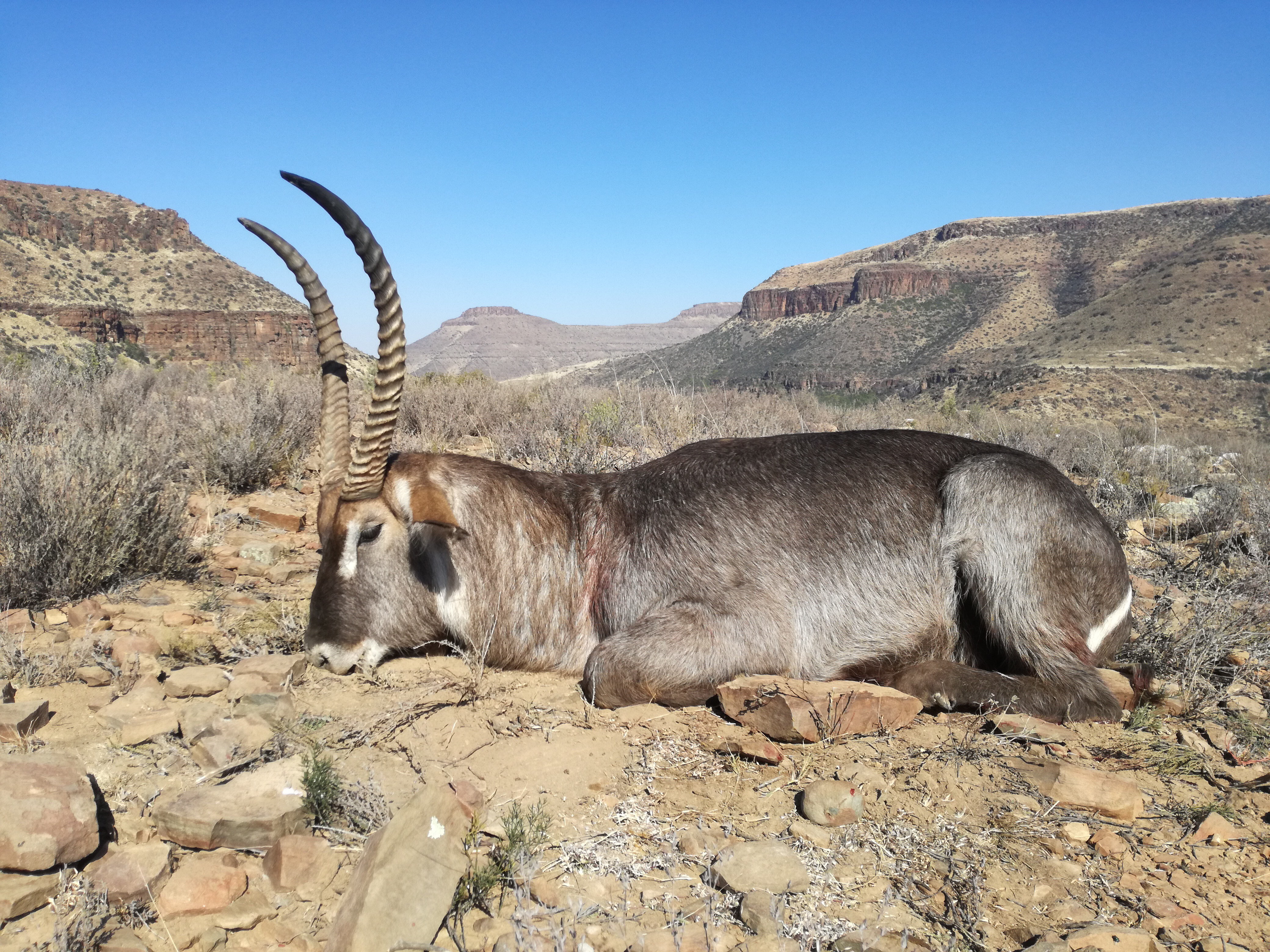
We prepared ourselves and headed down into the gorge before climbing up to a very happy young man with a beautiful old trophy waterbuck bull. Well past his prime and living his days out alone on the top of a mountain.
Photographs were taken and the stalk discussed. A perfect stalk followed by a perfect shot had produced the perfect challenge for a recovery.
We decided it was too late to go a get the horses so we would cut the bull into sections and come back in the morning to recover him. This would also give us the opportunity to put another theory to the test, which is that waterbuck tastes dreadful if you allow the hair to come in contact with the carcass. This is due to the oils on the hair spoiling the taste of the meat.
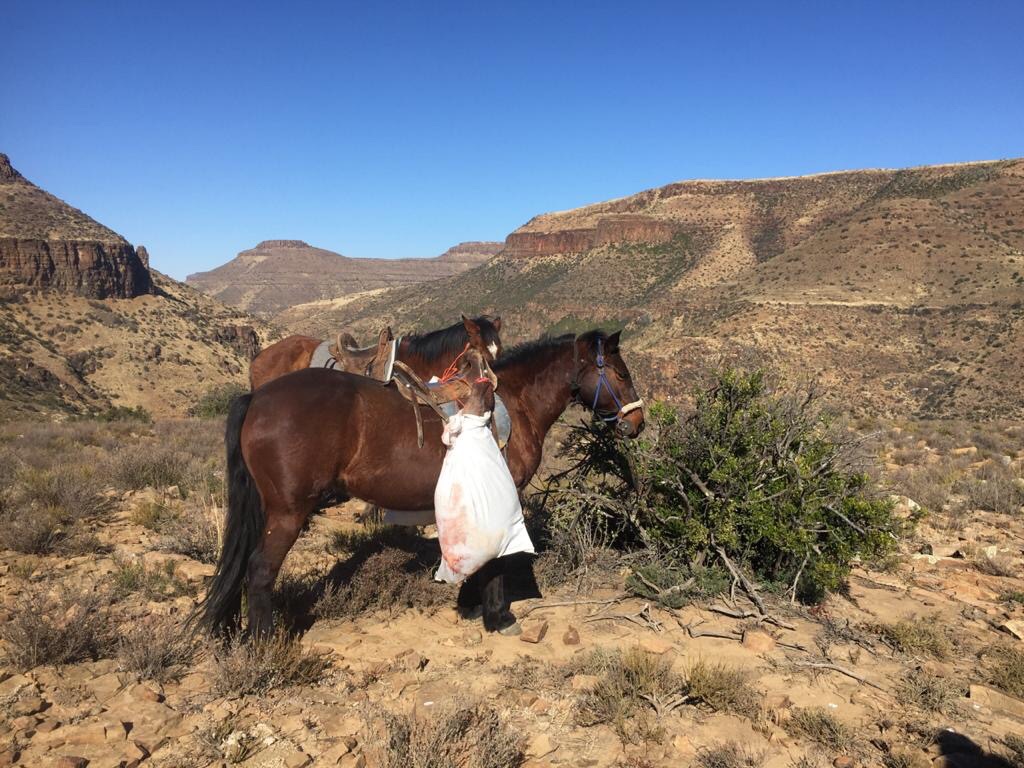
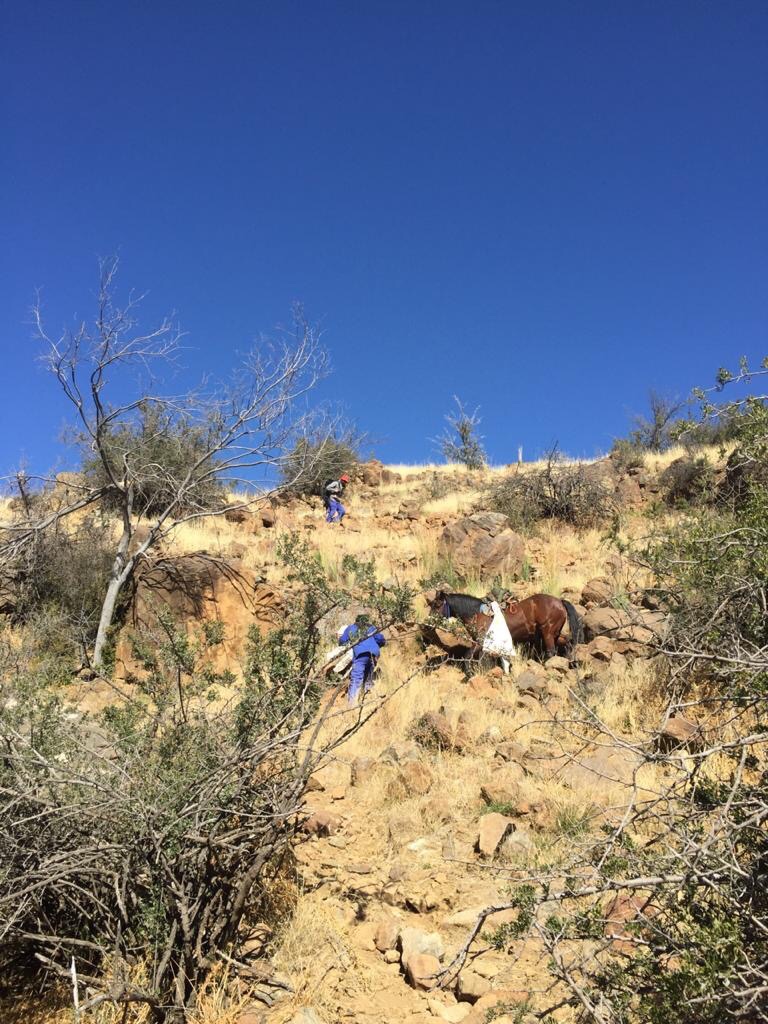
The following morning we were back out early with two horses and our backpacks ready for the recovery. Reaching the supposedly unrecoverable animal we began to load the carry bags on the horses. The one horse was very uneasy with this as it had never experienced anything like this before. It was decided not to cause the horse any undue stress and therefore she was let off the hook from carrying. The rest was put into the backpacks and the long hike back to the vehicle was underway.
Sometime later the vehicle was reached and a well-deserved bottle of water downed to quench our thirst. All the meat was taken to the cold room where it would be hung before being made into biltong (jerky). Except for the tenderloins which I have taken to make waterbuck wellington with. Not sure how it will taste yet but it will certainly be enjoyed by the hunting team around a table in the near future.
This hunt just shows that when a challenge is accepted and the will to achieve it is there, anything is accomplishable.
I look forward to the next hunt in this area where I am sure we will continue to learn how to make it easier to recover our harvested quarry and prove once again you can hunt successfully in the inaccessible areas.
 Hunting and Outdoor Adventures