I have had some clients and some people who are not say,
“I don’t know why you would want to shoot one of those”
This comment normally comes out when discussing a big cat, a zebra (Equus quagga) or more often than not a giraffe (Giraffa Camelopardalis).
On average I hunt two a season with clients. Not all had the intention of hunting one when they got on their plane to depart their home country but as soon as it is made known that these giants are available, they start the ball rolling.
Many believe they are a simple animal to go after and not a challenge. Most of this coming from seeing them from a vehicle or in an area where they are seldom hunted.
They stand and watch the vehicle or tourists go past and stare in their direction from their six meter vantage point.
This point is one that many don’t take into account. These animals reach six meters or 19.5 feet in height. With this is mind they can see your approach from far away. This is one reason why other animals stick around these periscopes of the bush. Nervous is an understatement and they will alert others of the slightest threat approaching from a good distance.
You then have two options for shot placement when you have managed to get unnoticed into range.
The first is into the body for a heart shot. Remembering that the vitals are not in the same place as those of other animals. Buy the book “the perfect shot” by Kevin Robertson before you venture down to hunt in Africa. This shot will result in the animal running. Offering more shots but could end in a horrendous recovery. I have been very fortunate with the body shot bulls I have guided on. They have all taken a couple of extra shots from heavy bore rifles assisting in them going down reasonably close to where the first shot was. These big bulls weigh in close to two tonnes or four and a half thousand pounds. You want it tall fall somewhere you can get a vehicle for the easiest recovery.
The second shot is for the head. This if done correctly will drop the animal on the spot. Quite impressive to watch as a bystander. Damage to the trophy won’t be an issue as the skull is like sledge hammer.
This personally is my favourite. If correctly executed it will give a clean and quick kill. No need for back up shots or chasing.
My first ever giraffe was with a great Texas lady who has from then moved on to achieve a great trophy collection. She decided to go for a big dark old bull on her first safari. We searched on a damp day for the herd and eventually found them. We saw the old bull, he stuck out being much darker and physically bigger than the rest. His size and strength had stopped other more fertile bulls breeding and the herd was no longer producing young. Possibly he was sterile due to age. We would harvest him and hopefully the breeding process would start again through a younger bull which was being kept on the side lines at the time. We moved in using a riverbed to get closer. Knowing that if we showed ourselves we would have a very long walk. The plan worked perfectly and we got in nice and close. A body shot had been decided on and the sticks were put up. The shot went off but hit a little far back. The bull started to run. Covering ground with incredible ease with each stride. Another shot hit but also not quite right. The third shot completely missed. Reloading started but the buck fever was fully underway and the shells spilt onto the floor. Then as the client tried to gather her thoughts and bullets she twisted her ankle.
Down on the floor now holding her foot. Her husband looked up seeing the giraffe making his way off. I was then instructed to sort it out. We followed quickly and as we got into range my tracker said for me to wait. I looked at him and he said you’ll see. As the bull dropped into a river bed and then reappeared on the other side. He then said “shoot”. I did and the bull stumbled from the Swift A-frame from my 375 H&H. I shot again and he collapsed on top of a small tree. Flattening it with ease. The bull had fallen right by the road. Perfect for loading. We were very lucky.
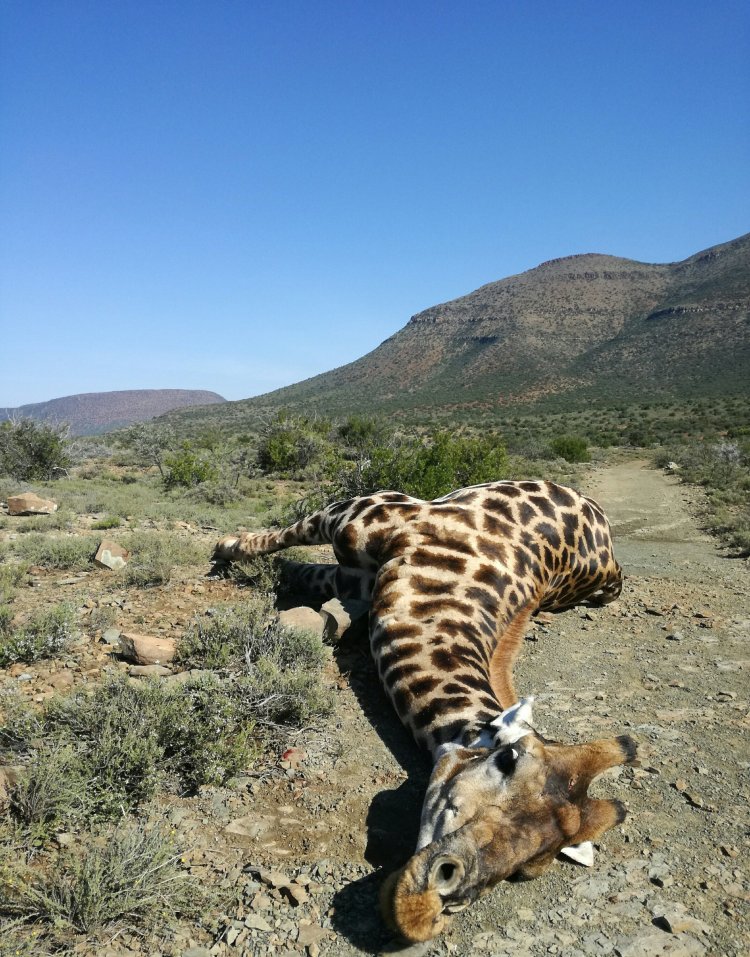
Another bull was in the same season with a perfect brain shot. Falling to a 300grain 375 Ruger. He fell where he stood. We had seen him from a long way off and he had seen us too. Rather than trying to stalk up and run the risk of looking suspicious we continued on a path which ran about 120 meters from the herd. They stood and watched us and when we were in the perfect spot I placed the sticks and the rifle was quickly positioned. Perfectly executed the bull dropped on the open plain for us.
The last bull was taken by this season and not all went to plan. The client had decided on the head shot but the shot went slightly back. Hitting the bull through the flesh on the back of its neck. Those of you who don’t know Africa may be interested to know that if you draw blood the animal is going onto your invoice. Thus we needed to get this bull down otherwise it was going to make for an unhappy ending to the hunt.
We followed this bull for a number of kilometres in which we had a faceoff with an elephant bull and avoided a herd of buffalo. We eventually caught up with him and again buck fever came to the party. Most would think it impossible to miss a target the same size as truck but I can say I have seen it a few times. The bull eventually went down and the team came in to do their work of recovery. Tractor, trailer and JCB.
What people must realise is that these old timers must be taken out every now and then to open space for new blood to spread through herds. The meat also goes into the human food chain rather than rotting on the plains. This protein is greatly appreciated on a continent where meat is a luxury to many.
So if you thinking of something big on your next safari, don’t rule out a giraffe and ask your outfitter if you are interested.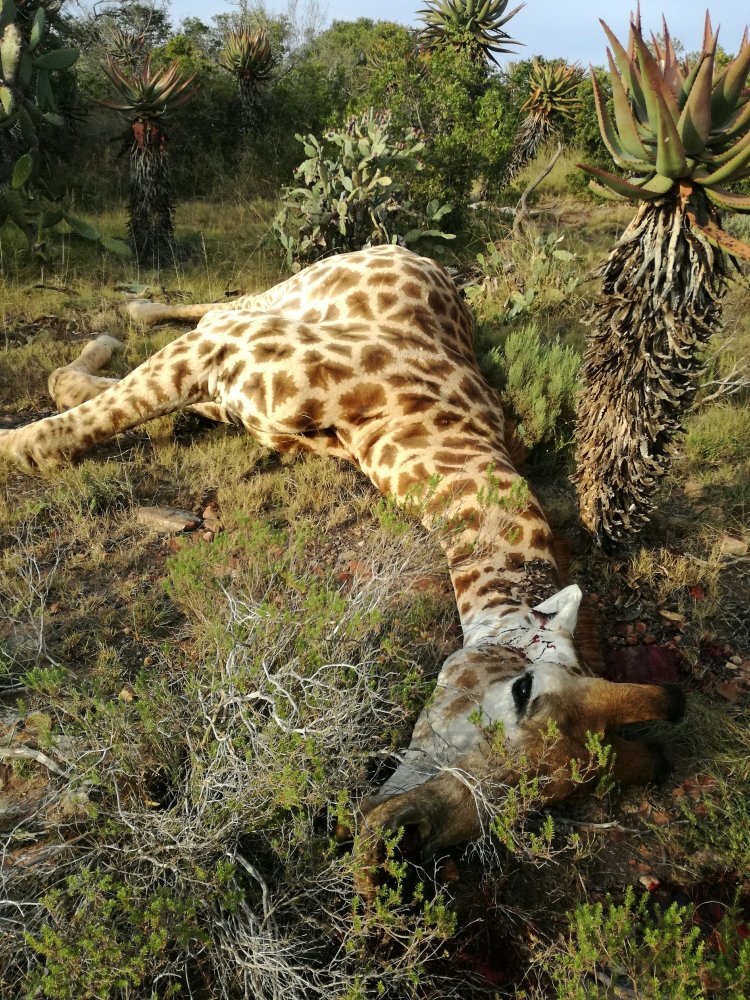
Lamb killer in the Karoo
It was a Friday evening and we were sat in the bar enjoying a couple of drinks. We live in an area where the main agricultural practice is sheep and goat farming so the conversation quickly took the line of how things were going in farming.
One of the guys in the group has not long been back on the farm from university and he brought up that he was losing lambs every night to either a jackal (Canis mesomelas) or a caracal (Felis caracal).
We discussed what the carcasses were like when he found them in the morning. Most of the lambs were eaten from the back end, where the prime cuts were taken but the crime scene was very neat and tidy.
This pointed in the direction of a caracal as a jackal kill is incredibly untidy which this was not. Lots of solutions were given to sort the problem out which was very kind but he would have to choose.
As the evening came to a close I asked the farmer what he was doing the following evening. He replied that he would be at home as he had nothing on. I offered if he would like to go out to his property and see what we could do to sort out this problem he was having. He was very grateful and we agreed that I would be there at 17:30 for dinner and we would then go out around the property when the sun had gone down.
The next day I got my kit together in preparation for the evening ahead. The swivel seat was attached to the back of the pick-up, spotlights checked, batteries in the predator caller changed, bullets and rifle packed. We knew it would be late and rather chilly so winter clothing brought out. It doesn’t matter what you look like when doing this job as nobody sees you so fashion statements are irrelevant. Warmth and comfort are number one.
As time got closer I started my way out to the farm. Only about 20 minutes from where I was living. The BBQ was on and the meal would be lamb chops. The finest in the world I believe coming from this part of the Karoo in South Africa. The sun started to fade and the time was getting closer to leave. A flask of coffee was made and some bits to snack on as we could be in for a late one.
I climbed on the back of the vehicle and put the rifle into its vice which held it in position. A spotlight fixed underneath the arm so that where the rifle pointed the light would too. The farmer climbed in and drove as he knew the target areas.
Driving out of the yard I started scanning with the hand held light for a glimpse of eyes shining in the dark. Mountain reedbuck(Redunca fulvorufula), a genet(Genetta), some kudu(Tragelaphus strepsiceros) but no predators yet.
We drove down to the area where a lamb had been killed the night before. Finding an area which gave us a 360 degree open area so we had good visibility of anything which may approach.
I climbed off the back of the pick-up and went and put the caller out. Returning to my seat I sat quietly for about 15 minutes letting things settle down after our disturbance. I had decided to use a food call for the caracal hoping that the sound of a squealing rabbit would entice this night time killer out of its hiding place.
Pressing the button on the remote the eerie sound of a caught rabbit rang out in the darkness. Putting on the spotlight I swivelled my seat round lighting up the area around. Nothing so the light was put off again. A couple more squeals and I span again. This time at a distance in the thicket to the mountain side of the caller I caught a glimpse of an eye flash. Was this the culprit coming in? It was too far to say at the moment so I turned the light off and continued to call. Spinning again with the light I saw the eyes moving closer. This had to be a predator as nothing else would be so inquisitive over a prey call.
Through the scope I checked. I could see the tufts on the top of the ears. It was a caracal. Coming in stealthily. I told myself to wait until it came closer. It had no idea that we were there. Slowly it moved forward approaching the caller.
It was time. Possibly 100 meters away. I could see it clearly through my scope. I tracked it as it walked in. Then it stopped just for a second and this was my chance. Cross hairs on the shoulder, I pulled the trigger. A hit and the eyes vanished. It was down.
The farmer who was in the cab was unsure what was going on and when I told him he couldn’t believe it. He walked out to the spot I lit with the spot and he returned with a big female caracal.
We loaded it and I took another anti-histamine tablet as I am allergic to cats and they make me sneeze which I don’t find useful when trying to hunt them at night.
We drove again scanning with the light to another spot where there was a chance that another caracal was living. We sat again and the whole process started once more. I thought I would use the same call as it worked the first time.
Within minutes of calling another set of eyes appeared approaching the caller. Surely not another caracal. In it came. Just as sneakily as the first one.
Through the scope I could see by the way it moved that it was another one. Again I waited until it was closer. As soon as it was in range I fired and we had number two in the bag for the night. This time the farmer had been able to watch the whole thing as it approached from the front of the vehicle.
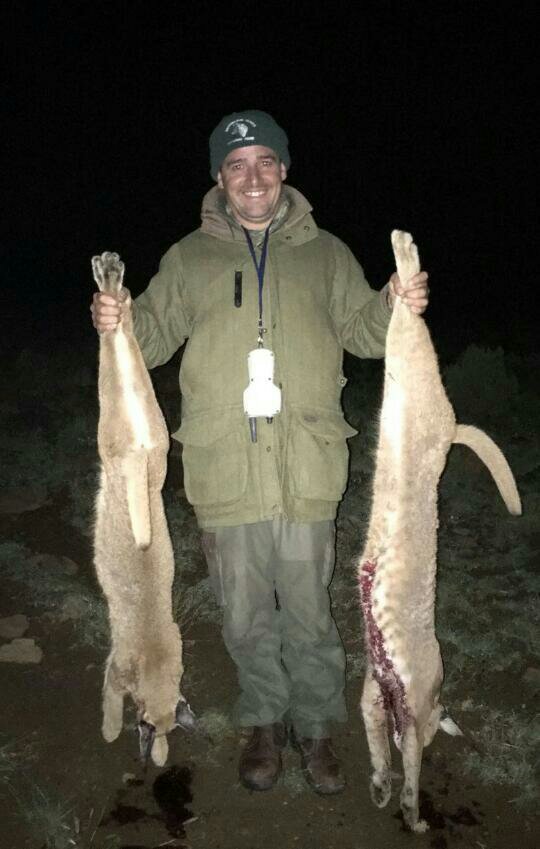
Both were good sized females. One weighing in at 13kg’s and the other 15kg’s. Both in very good condition which was to be expected as they had been living on a diet of fine lamb.
The farmer had a break for a while but we both knew that others would move in and the losses would start again. We would just have to keep our eyes out and expect that we would be out again in search of this beautiful but deadly predator.
IT’S NOT JUST ABOUT YOU SHOOTING SOMETHING YOURSELF
I have hunted for many years now both on my own and with clients.
Some of them young with the possibility of many more safaris to come and others are older and nearing the end of their safari history.
Some of the hunts I like the most are with children or even just newcomers to the sport. These clients are eager to learn of new things and the look on their faces when the plans come together are priceless.
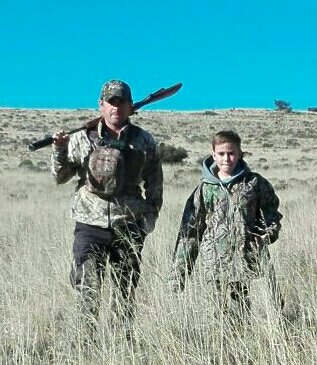
The most enjoyable though for me has been able to hunt with my own children and see them enjoying their time out in the field. Not every hunt has been successful. Many of them have brought frustration as we are normally looking for specific animals to take out.
My eldest son who is now almost eighteen started off with me in the UK on pheasant shoots and in pigeon blinds. When we returned to live in South Africa he started to hunt plains game. His first was a common blesbuck (Damaliscus pygarus) hunted on a farm north of the town called Graaff Reinet. A day I will not forget and I am sure he won’t either. From there he has hunted many different animals from an array of species. Mountain reedbuck (Redunca fulvorufula) in the high country, springbuck (Antidorcas marsupialis) on the plains, kudu (Tragelaphus strepsiceros) in the bush and scimitar horned Oryx (Oryx dammah) on a friend’s property. Many long days which have hopefully been as much fun for him as it has been for me. He has even had the opportunity to return to the UK and be invited on driven pheasant/partridge days. Dressed in full tweeds as would be expected.
My youngest son also got into the action a couple of years ago, starting on mountain reedbuck with a one shot kill in the hills. More springbuck and mountain reedbuck have fallen for him since that day and I am sure he will continue.
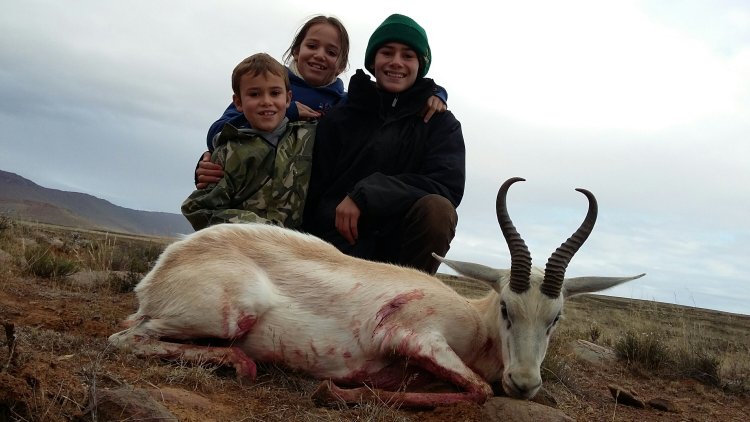
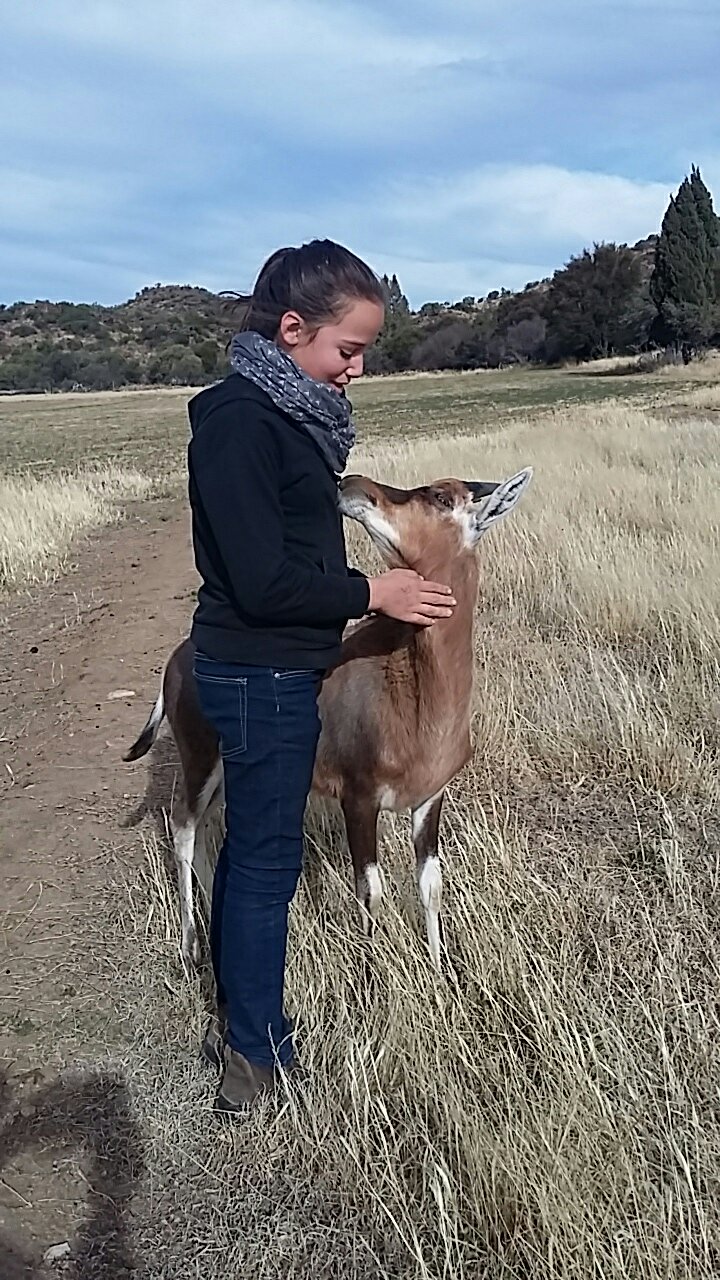
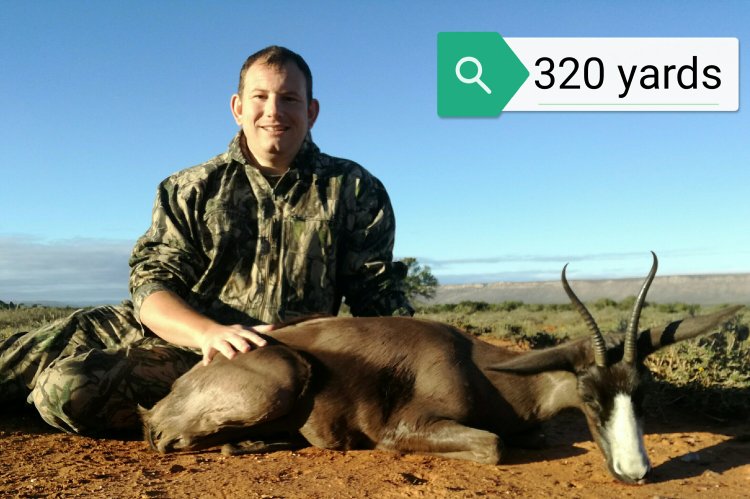
This year my daughter decided that she was ready to give it a go. A keen air gunner and someone who joins us on many a hunt but had always said she wasn’t quite ready to pull the trigger on an animal just yet. Her first springbuck was taken with a perfect heart shot using my 308. She gutted it and has done everyone since which she has shot to date.
It gives me as much pleasure, maybe more actually when I see one of them navigating their way through a stalk and being blessed with the success of an animal at the end of the day than for me to pull the trigger.
My children know where their food comes from, especially the venison which is in our freezers. They understand that to keep a healthy population of game on a property or in an area you need to be able to control their numbers.
Knowing that my children enjoy to get out of town and into the outdoors with me is great. We get to spend valuable time together and we have time to talk about many more things than just hunting. We see and go to places where others don’t manage which for me is a blessing.
We need to introduce as many new comers to our sport as we can. The pressures which the hunting communities face every day around the world aren’t going away. Many people have a twisted idea of what we do in the field due to lack of understanding and the wrong type of exposure. The anti-hunting lobby voice their opinions without worry of offending anyone or giving half-truths of what is going on.
If we as hunters can show people that there is a real purpose to what we do, it will help us and our children in the future. If it means taking someone out for the first time and letting them see what you do or letting them shoot their first buck will help. Even the kind gesture of giving someone a processed buck, be it a whitetail deer from the USA or a springbuck from South Africa makes no difference. Every little helps in to ensure that we as outdoors people can continue our quests in the future.
What else is there to do?
Many of the clients who come over to Africa to hunt just want to hunt. Others on the other hand want to experience some of the other activities that Africa has to offer.
Being located in the Eastern Cape of the country we have around 800km’s of picturesque coastline.
This is quite a pull to many of the people who come over. Some just want to put their feet in the Indian Ocean to say that they have done it but others want to tick a box off their wish list. This box for many is to wake up early in the morning and head down to the beach. There waiting for them is a boat for their arrival to take them out onto the ocean in search of what hides beneath.
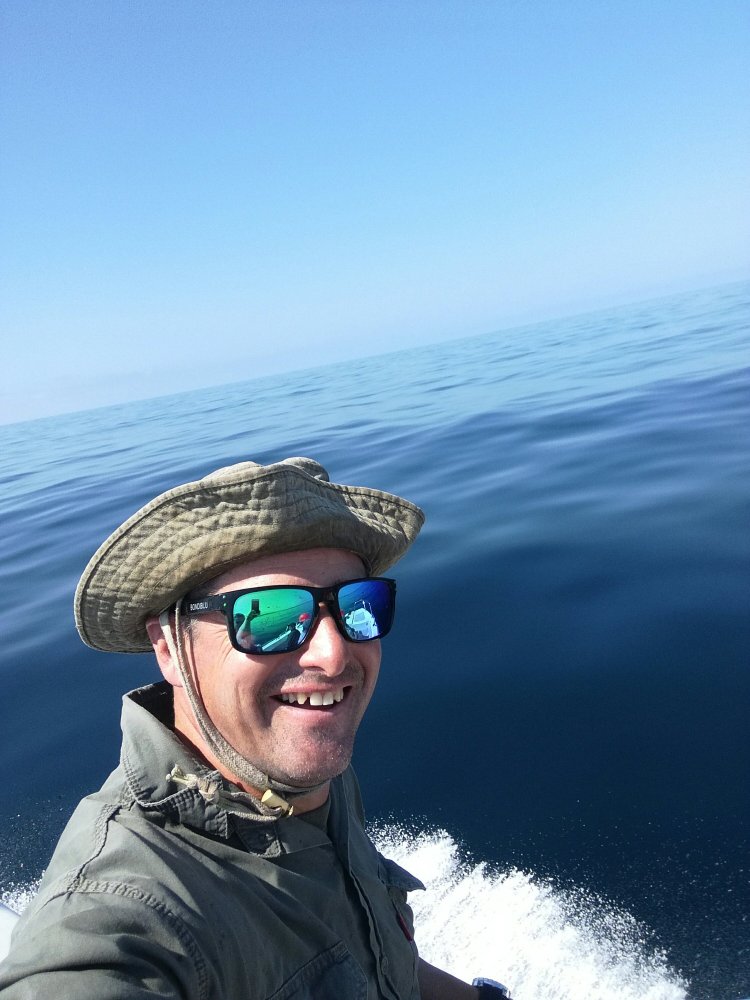
A few years ago I was lucky enough to hunt with a great group of guys from Alaska. They were proper outdoorsmen. Enjoying the hunting where they back a number of good trophies but also had the love to catch fish. One even travelled where ever he went with a small spinning rod just in case the opportunity arose for him to wet his line.
We headed down to the town of Kenton on sea the day before as we knew it would be an early start. Heading first to the post office to buy our fishing licences and then off to our accommodation.
The following morning we woke to a beautiful day with an ocean outside as calm as could be. Perfect in every way.
We headed down to the beach where we met our skipper for the day and saw our transport for the day. We climbed aboard while she was still on the beach and trailer was slowly pushed into the sea for the start of our adventure.
After about 20 minutes our captain, whose name was Shane by the way slacked off on the throttle. His fish finder was indicating that we were above what we were after.
The anchor was dropped and he and his crew member started to prepare our rods. Not quite the traditional equipment I am used to from the river fishing in the UK. The rod was a typical sea fishing rod but the reel. Well it looked like the front wheel off a child’s scooter which had line on it. There was no bail or drag just a free flowing wheel with line on it. The line was armed with two large hooks which were to be baited with sardines and lowered to the bottom. This lowering didn’t go well the first time, managing to make a nest of line which any bird would have been very proud of. I was quickly given another rod and a lesson in how to slowly lower the bait to the deep depths.
Holding the reel correctly now I let the bait down to the bottom of the ocean. After a while the line stopped which indicated it had reached the bottom. Reeling in slightly I waited. Not having done much sea fishing and using a rod possibly two or three times thicker than usual I was not exactly sure if I was getting a bite or it was just the currents playing with me.
Suddenly on the other side of the boat a voice rang out, “I’m in”. Then another one of the guys announced loudly that he was in the same predicament. The rod tips were bent over and the guys reeled in. Fighting their quarry and bringing them up to the surface. As they reeled up they suddenly saw a glimpse of their opponent. Just a flash of pink down below. The excitement grew as these keen anglers got closer to seeing the new species which they had gathered.
This continued for us all for a while with us bringing up a couple of different species each. Sometimes two on the line at the same time which made for a good battle bringing them up from the deep.
We then reeled in and headed for another spot to work on the opportunity of some more species. The boat glided along over the calm water with the coastline far in the distance. The engines again slowed and the anchor was dropped. We were above another spot. Lines were dropped without issues this time to the deep. Quickly we started to feel the bites. Fish were here and we were in for some fun.
All of a sudden someone said “shark”.
All eyes started looking around. Then right in front of me a fin appeared circling the boat. A four meter great white had decided to come and investigate what was going on. The memories of watching the movie Jaws quickly came to mind. The captain announced that he knew this particular fish and it regularly popped up in this area. As quickly as it arrived it was gone. With this it brought to reality that we were not in charge out here and if we ended up in the water we were part of the food chain and not at the top.
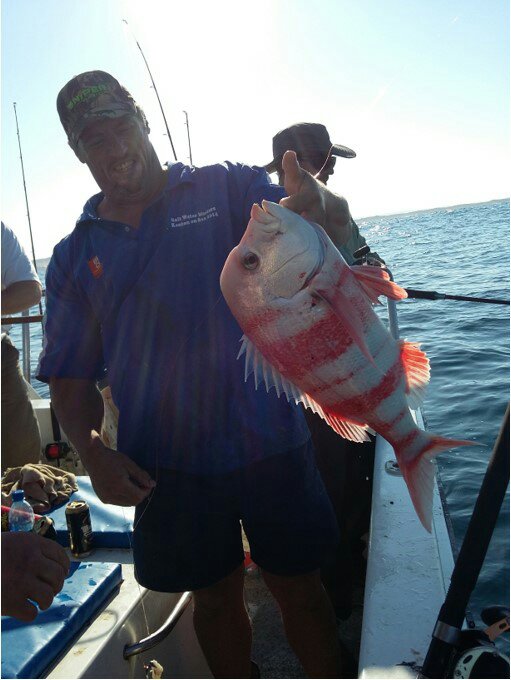
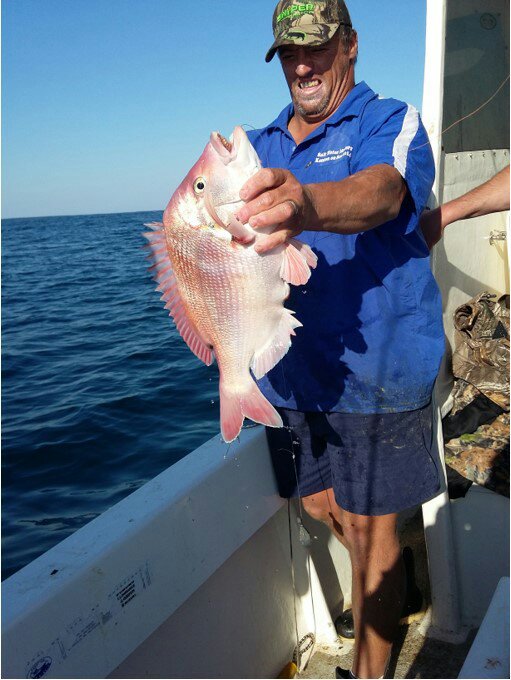
The day continued and we all caught good numbers of fish ranging from mussel crackers, red snappers and a couple of others.
It was now time to head in. We headed towards the beach. When we were about two hundred meters off shore we were told to hold on as we would be navigating at speed through the reef and then up onto the sand. The throttle went down and the bow raised up. At full speed we hit the beach, driving us up off the ocean. The tractor and trailer approached and pulled us further up and we disembarked.
We thanked our crew and hosts and prepared to head home. Then we were asked “where are you off”?
The day had not ended. We all headed back to the captains house where all the species harvested during our day was to be prepared for us accompanied by chips, salad and freshly baked homemade bread. Washed down with a couple of beers and toasted with a tot of rum.
What a fantastic day and an experience of the Eastern Cape of South Africa not to be missed.
Hunting from the coast to the mountains
The hunt was booked. I saw the wish list which made me check twice.
It was a varied request which you don’t often come across. This client was definitely not on his first safari to Africa.
Mostly you see game such as cape kudu, gemsbok, impala etc. on the list. This was far away from those regular species.
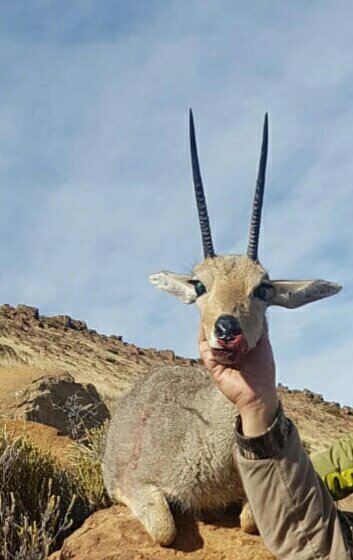
We had blue duiker, cape grysbok and Vaal rhebok listed. We were certainly going to visit some varied locations in the next couple of weeks.
It was August so the weather was wintery, with pleasant days but cold nights. The clothing to pack would definitely contain some of my UK hunting attire as it seems to withstand the cold slightly better than the South African gear.
First of all we would head to the coast for the blue duiker and the cape grysbok. Two animals which form part of the tiny ten antelope. These would complete this prestigious accolade for the client which he had been slowly working away at for many a year.
The plan would be to do the blue duiker first and then head slightly inland for the grysbok.
We met with our host and drove to a property overlooking the Indian Ocean.
Here we would make our way into the thick bush in wait for the smallest of antelope to appear. The three of us would wait patiently with our eyes peeled on the small footpaths in the thickets. At the other end of the thicket two jack Russell dogs would be unleashed to pick up the scent and hopefully disturb the animals to run away and into our line of sight.
Armed with a shotgun we listened to the distant sound of the dogs which had obviously picked up the scent.
We knew to get ready as the sound of the dogs approaching meant that the blue duiker would quickly dart by in front.
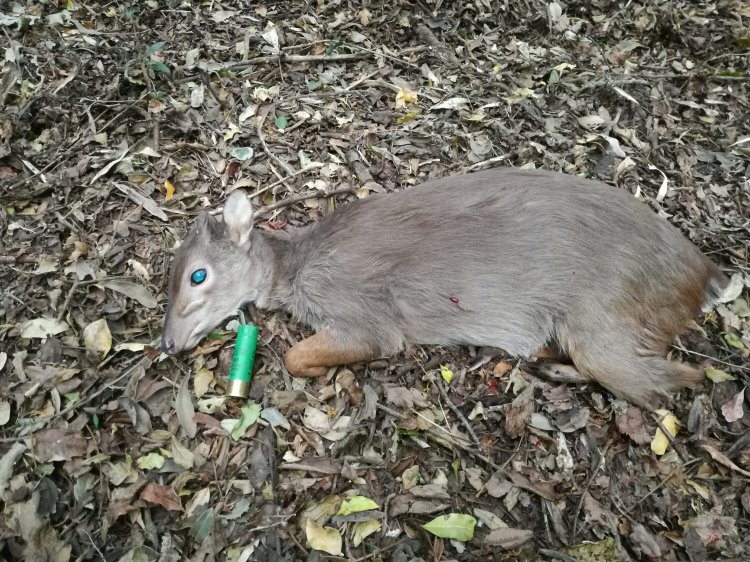
Suddenly a flash of movement and the shotgun fired. In front of us down the track tumbled the small antelope. We moved forward to collect our prize before the dogs arrived. The client was like a kid in a sweet shop. Happy and surprized at how quickly he had had to react.
We moved back to the farm house overlooking the sea where a comment came out from the tracker who was originally from the Northern parts of South Africa that the farmer which owned this property had to be very wealthy. I ask why as there was nothing extravagant about anything to see. He said that to own a dam that size he had to have money. We then realised that he had never seen the ocean and a plan was quickly made to take him to put his feet in the great block of water which we all knew as the Indian ocean. These experiences make hunting special.
We then headed a couple of kilometres inland where we were lucky enough to bag a cape grysbok during the day which is quite a feat. He was spotted sunning himself on a bank and we quickly made ready and the tiny ten was complete.
The third animal on the list would take us inland about 300 kilometres and raise the altitude to over 2500 meters above sea level. This is where we were going to find the Vaal rhebok.
We arrived that evening in the small town called Nieu-Bethesda. The weather had certainly turned and a cold front had arrived at the same time as we had. The temperature that night dropped to -10 degrees centigrade which made leaving the lounge heated by a log fire at 06:30 quite difficult.
We did get out and defrosted the hunting vehicle which was also a new experience for the tracker as the only ice he knew was that which was put in a drink.
We headed for the mountains. The sky was grey and the cold climate reminded me of those cold wintery days I had spent hunting in the UK. Not long after leaving the town the snow started to fall. Small flakes to start with but it quickly changed to a full blizzard as we started our climb to the farm.
This hunt was going to be very different. Up to our knees in snow we glassed the mountains for our designated quarry. Eventually finding a nice ram high up above us. We moved in on him to where we would be able to get a shot.
The snow had stopped falling but it felt as though we were on another planet. Laying the rifle on the rucksack we took the shot. The ewes which made up his harem bolted but he was ours. Photos were taken and we started the journey down through the snow.
There were two men on this safari who had new experiences on this trip. One was the client who got his new animals and completed a chapter in his hunting journal. The other was a tracker who for the first time in his life had seen the ocean and in the same few days saw snow.
This for me is one of the great things which hunting does. It exposes people to new things whether you are the client or the staff member, which can be shared with others who may never have the chance to experience it.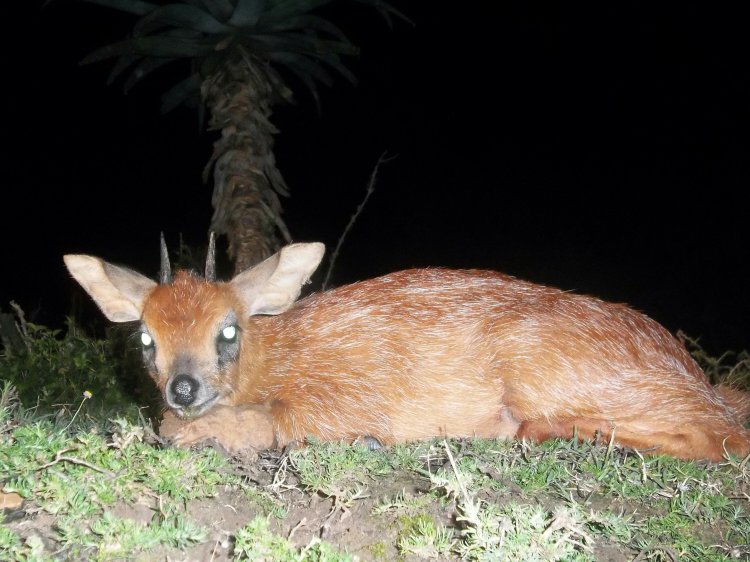
Film or not to film?
Many of the people that I hunt with tell me that this is the hunt of a life time and that they have dreamt of this day since they were in their teens.
I am of course talking about clients coming to South Africa and hunting here. Whether it be for plains game or for dangerous game it makes no difference.
Memories made in the outdoors are never forgotten but some part of the trip maybe put into the back of your mind. Especially when you return home and your friends, family or interested parties ask you about your trip.
If the hunt has been successful then you will have pictures on your phone or camera of a number of dead animals. Whether they be from a trophy hunt or management does not matter. They are still pictures of your time on safari.
Then all of a sudden people start to ask what the lodge was like, how was the terrain, what vehicle did you use. At this point you have nothing to show. Mainly because as you are stalking in on your trophy the last thing that goes through your mind is that would make a nice picture to show my friends.
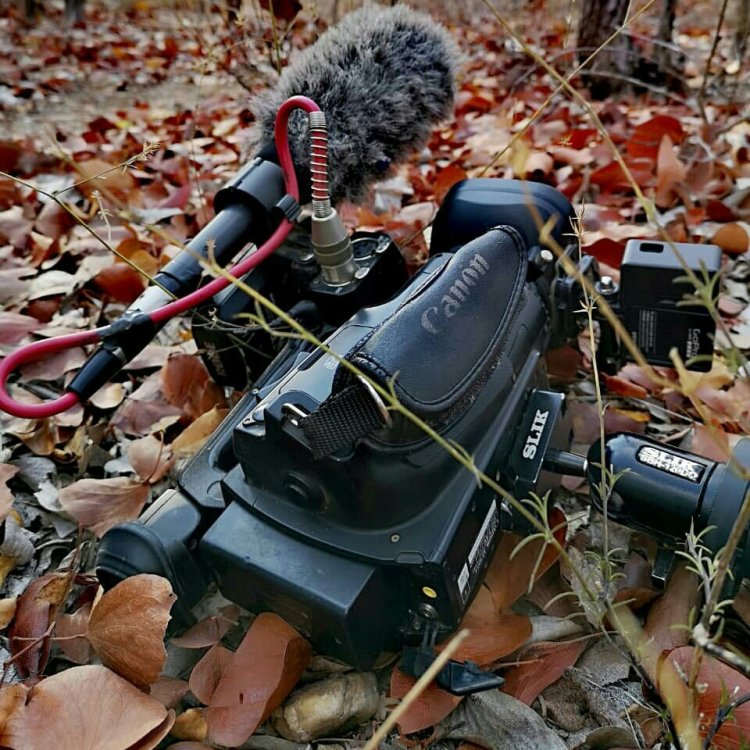
Having someone who knows the bush and moves the same as you do but is capturing your journey on film is amazing to have at the end. They get the shots which you would never think about and see things you never imagined were there. I am talking about the professional cameramen who accompany many clients on safari to capture their amazing holiday on film.
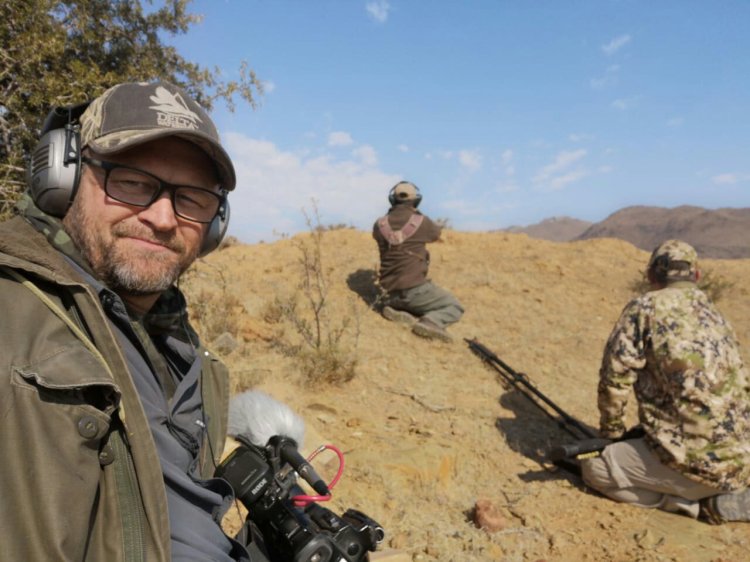
One such guy who I have often had the privilege to have along with me is a guy called Paul Ruschenbaum. He does not get in the way and certainly doesn’t poke his head around a bush to see what’s going on. Scaring all the animals away in the process. His eyes are always working and often points things out to us and has never had an issue climbing a mountain only to find out the targeted quarry has gone down the other side. He just takes it all in and enjoys the moment. Taking some scenic footage so that everyone gets to see that Africa is not just a flat piece of savanna grassland as you see on the television.
He carries both a video camera and a digital camera 99.9%of the time, so not to miss an opportunity of capturing that perfect moment for you.
Having someone else along makes some people nervous that dragging an extra body on a stalk will give the game away. I have never had this. To be honest he is usually quieter than the clients as he knows that if he gets busted then it doesn’t go down well. Every now and room then in the beginning you do hesitate, hoping he has everything ready as once the bullet flies there’s no doing it again like in the movies. He is normally one step ahead filming and knowing the time is coming. The only question normally is for me to just let him know which animal, if in a herd we are going for. This just makes for the impact shot which many people like to replay when the hunt is over.
In the evening when you are sat in the lodge enjoying a cold beer Paul is either stalking around getting those non hunting pictures or otherwise he is sat in his room editing the day’s footage. Making sure that there is a basic copy put onto a storage disk ready for the client to take home. They will later get the fully edited version with all the video footage as well as the still photography he has taken.
You have to admire him as on a number of occasions he has been stalking along behind me armed only with his camera. Putting his safety in our hands against an animal who will happily grind you into the floor as you get into its comfort zone. He has followed us into the shadows as the sun is quickly retreating capturing the clients shot on a buffalo or taking a kudu of a lifetime. Capturing our every movement and saving it on film for us to watch over and over again with our friends and colleagues.
I have watched footage after a shot to confirm the animal was actually hit and also to see where the shot hit. You then know what situation you are placing yourself into.
Being the cameraman certainly gets you into places which a normal 9-5 job doesn’t. Paul has been on many a safari and has witnessed many a buffalo fall, a dart fly true on a rhino green hunt and a crocodile stalked along the meandering rivers of Africa.
Don’t think these guys will be a hindrance on your hunt. They will make it complete for you. They will also put some bloopers in for your amusement which you are more than welcome to hide from the viewers you show it to.
Therefore when you look at booking your first or your next safari, ask your outfitter if they have anyone who does film work for them as you would be interested in recording your safari. If you are in the Eastern Cape of South Africa you won’t go wrong by finding out id Paul Ruschenbaum is available to save your memories.
Buffalo at last light
After you have been to Africa hunting a couple of times and shot quite a few of the plains game species, the next step is to move up to bigger things. These being your move to the big five or dangerous game. Elephant (Elephantidae), rhino (Ceratotherium simum), lion (Pantera leo), leopard (Pantera pardus) and probably the most common to hunt, the Cape buffalo (Syncerus caffer).
This animal has been written about by many authors and one thing they all have in common is the respect for the unpredictability of this quarry.
Some people would ask why you would want to shoot a cow. These are people who have very little knowledge of this animal as you never know what mood it woke up in that morning. One very experienced buffalo guide I have worked with told me that it was easy to kill a buffalo, it was just convincing the buffalo to die was the hard bit. They can take a lot of punishment to put down and if they get hold of you, you will certainly come off worse for wears.
The client I was hunting with had hunted a number of times with me and had got through most of the plains game. He had now decided to take that step and had booked a buffalo hunt. He had purchased a Sako rifle in 375h&h which is a great calibre for the job. He would shoot an aimed shot hopefully so had put a scope on with quick release mounts just in case there was an issue.
We arrived at the property at around lunchtime so got settled in and had lunch before going to the range to make sure everything was still working as it should be after our long journey. This was not to be. The scope was loose in the mounts so some work had to be done. We eventually got everything on track and the 300 grain Barnes bullet was hitting the bull’s eye spot on at 100 yds.
As we still had a few hours of daylight before us we decided to head out and see what we could and maybe have a chance of catching a glimpse of buffalo for the next day.
We drove out of camp and saw abundant numbers of game over the diverse terrain of flat savanna and rocky out crops.
After about half an hour of driving we decided to leave the vehicle and take a walk down to a small watering hole to check for tracks of buffalo which had maybe been there to drink.
We got ourselves ready. The client with his 375h&h, myself with my 458lott which looks like it has been through the wars but shoots perfectly straight and another PH with his Heym 470 double. This last rifle being a beautiful piece of rifle craftsmanship and it is ideal for the job it is made for.
We walked slowly down to the watering hole keeping our eyes peeled on the shadows of the thick bushes knowing this area was rich in buffalo and that the heat of the day would probably bed them down out of the sun. As we walked around the water’s edge we found tracks of numerous species including buffalo which had frequented the area within the past day. While we did this one of the trackers climbed a small hill to glass the area the other side.
He quickly returned informing us that he had seen a buffalo bull go into a thicket of acacia Karoo on the other side and he thought we should go and look as it seemed to be a nice one in his eyes. We followed him slowly up the side of the rocky outcrop to a vantage point overlooking the thicket which the buffalo had entered.
We sat and waited, glassing the shadow hoping for a glimpse of the bull. Nothing.
A blue wildebeest slowly wondered past and we looked at the tracker hoping this was not what he had seen. Then we heard the noise of branches breaking deep in the thicket so we were reassured he had seen correctly and there were probably buffalo within this thicket of darkness and thorns.
We sat and continued to glass. Hoping that this bull would show himself. Still nothing and the sun was starting to drop.
We had to make a decision on what to do. Leave and come back in the morning. Which could mean that he moved on and we would never see him. Or, we could slowly move down into the shadows and go look for him.
Myself and the other PH quickly discussed the options and we decided to head down into the shadows in search of our quarry which we had not yet seen.
Moving slowly through the thicket in full anticipation that at any moment we would come face to face with the beast our adrenalin was running high. Your eyes play tricks with you and you think you can see the large dark shape under every trees shadow. Slowly moving forward we scanned from side to side. Still nothing.
Then the breaking of branches again. Not like something running through them but that of something rubbing themselves against the tree and breaking the branches off with its weight. We stopped, crouching down to try to see under the canopy of the low branches for any sign of legs. It was too thick.
Then ahead of us, about 150 meters we saw a black shape moving slowly out towards a small hill.
The other PH with me has many years of experience of buffalo hunting in the area and quickly gestured us to take off our boots and head forward in our socks. This to make sure we walked carefully and quietly so not to give away our presence.
We quickly did as we were told and certainly moved carefully forward with all the thorns on the ground poking our now unprotected feet.
The bull moved slowly and unawares of our presence up a small hill. He was not going to give us a shot. We got the client on the sticks and told him to get ready.
We then let out the bellow of a wounded calf which certainly got the reaction intended.
The bull stopped.
The word “shoot” quickly came out and the 375h&h went off. The bull was hit and jumped on the impact. The client quickly worked the bolt but didn’t pull back far enough so his second attempted shot just clicked. He very quickly corrected his mistake and a second 300 grain bullet struck home. The bull the disappeared over the ridge out of sight.
We quickly put our boots on to follow up the hill.
All three of us at the ready for what was waiting on the other side. As we reached the top we saw three other bulls goring the hit bull on the ground. Maybe now showing their dominance over him as he had surely been the biggest of the four. We shouted at them and they turned and fled into the thicket on the other side leaving our bull lying on his side mortally wounded.
We moved in behind him and instructed the client to put in another shot between the shoulder blades as an insurance shot. He did and the game was over.
The first shot had been a good one. He would not have gone far but as is customary practice on dangerous game an extra shot is sometimes a life saver. Surprisingly there was no death bellow which is often heard when a buffalo is dying.
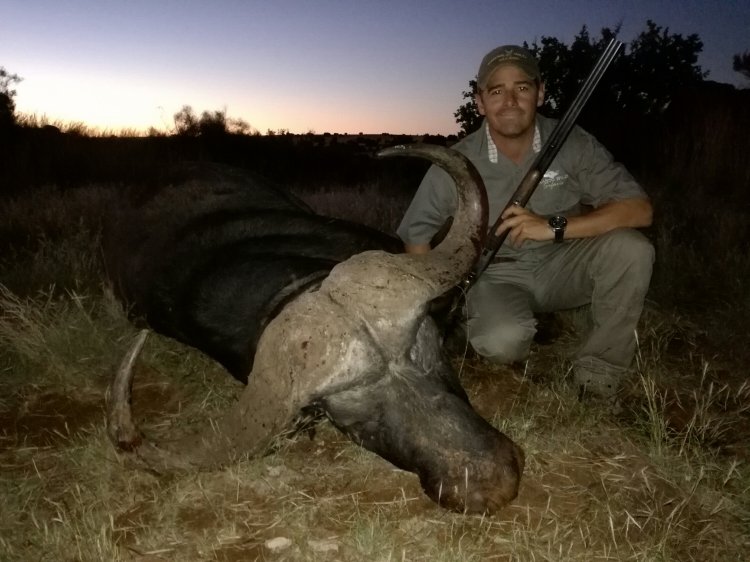
We called in the recovery team and got the photos taken before it was too dark as the sun was definitely fading.
We headed back to camp with a very jubilant client who was already planning his next trip which would definitely include another buffalo hunt which he wasn’t telling his wife about yet.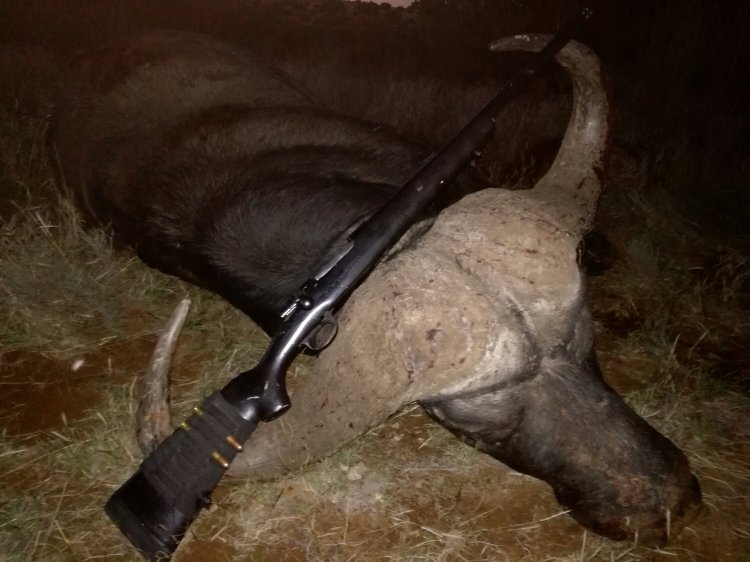
Expect the unexpected.
The day started with myself and a good client heading up the mountains in the Eastern Cape of South Africa in search of an eland bull. We had already bagged one fantastic trophy on this hunt but eland was to the client a special animal and if he could, he would hunt them every day instead of any other quarry.
The road up was rough but worth it. The views from the top were magnificent and on this particular morning the cloud cover was low so we were going to be hunting above it where the air was fresh and clean.
The plateaus at the top were home to a number of species such as black wildebeest (Connochaetes gnou), blesbuck (damaliscus pygargus), springbok (Antidorcas marsupialis) and mountain reedbuck (Redunca fulvorufula). The eland (Taurotragus oryx) were often up there grazing on the thick grasses which covered the surface of the high ground.
We reached the top of the steep road and climbed out to check what was about. All of the above species were in view except for the eland. We walked on checking over the ridges but saw no sign of them. Sitting and glassing the far hills there was still nothing. After an hour or so of scanning and seeing nothing we decided to head back down and check other areas.
As we made our way down my tracker whose name is Cocoa tapped on the roof. I looked up at him in the side mirror where I saw him gesturing for me to come out. I got out and moved slowly to the back of the vehicle.
High up on the side of a ridge stood a herd, possibly 20 in number. We looked through them with our binoculars but didn’t see any bulls with the attributes of a fully mature bull. If you are wondering what I mean by this, I look for a bull dark in colour ( almost blue), a big dewlap, thick horns and a tuft of thick hair (kaif) on the front of his forehead.
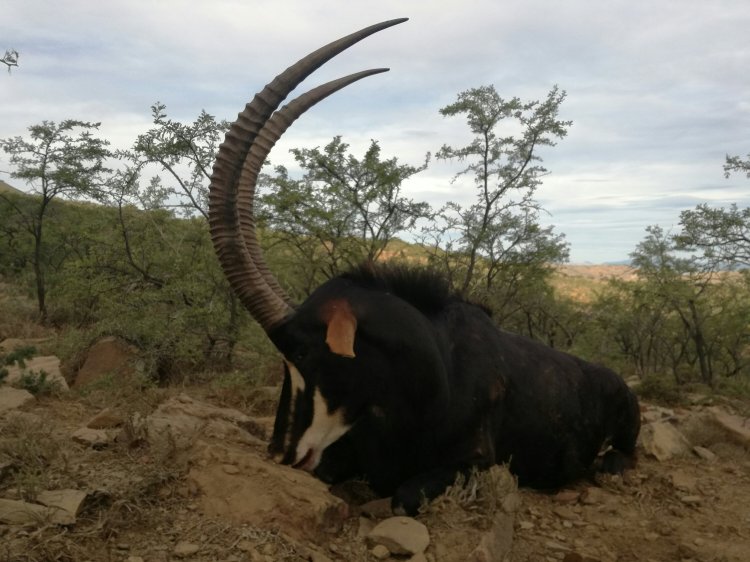
We continued on down the rough road until the tap tap came on the roof again. I stopped and Cocoa was pointing in front of us. There stood a dark black figure under a tree about 350 meters away. I raised my Steiner binoculars and looked to see what it was. A sable (Hippotragus niger) bull with long sweeping back horns stood relaxing in the shade. I told my client to have a look which he did but then informed me he would rather have another couple of eland.
Then he spoke again and said that his hunting companion in camp would definitely not turn such a magnificent specimen down.
We slowly moved off in the direction of camp as this opportunity was one I was not going to let go. On arriving in camp the client hunting with myself quickly informed his friend of our sighting. From where I was I could see a large smile appear on the clients face. He came quickly over to my vehicle and asked if I thought the bull would still be there. I explained that he looked quite relaxed when we left him and that we had not disturbed him at all.
He then asked what we were waiting for.
He climbed in with his friend and we headed back to the area. He was gone. We climbed a high vantage point to see if there was any sight of him but nothing. The bush was thick but there was no sign of him at all.
That evening we sat and discussed the following morning. We agreed that the bull was probably still in the area and that we should give it another scan after breakfast.
The following morning on sunrise we were heading out. We reached the area and soon we saw the glint of this magnificent animals horns as he lay catching the first rays of warm African sun. Myself and the client left the vehicle and the rest of the crew and made our move.
We would cross over a dry river bed and climb the opposite ridge to get a good view on the bull. We did this keeping our eyes peeled for any other animals which would certainly give the game away. Slowly we edged up the ridge and every now and then we would catch a glimpse of our bull still in the same place. We were now within 120 meters of his position. His sixth sense told him something was wrong. The wind was perfect and we had not made a sound but he was staring straight at us.
I positioned the shooting sticks and the client steadied his 30-06 on them. He found the bull in his scope and fired. The bull reacted by jumping in the air and started to run. Another shot quickly rang out and I saw the bull go down. It looked like the second shot had taken him a little far back but had possibly broken the spine.
We made our way over to him and found him lying under a bush. I could see he wasn’t dead so informed the client to put another round into him. He did and the bull didn’t move.
I congratulated the client on a magnificent trophy which would most certainly take pride of place in his house. He agreed and I moved towards the bull. As I slowly moved around the bush towards what we thought was a now dead sable, armed with my shooting sticks and a holstered 9mm.
The bull got up. I was only about 3 meters from him and I had no chance of getting away. He was set on getting his revenge on whatever was closest to him and that was me. Completely by reaction I drew my handgun and fired. Within the split second it took I remember it going through my head not to shoot the bull in the head. Both bullets struck home in the chest and then there was a boom from my left. The client had realised and fired as well. The bull fell.
We watched him to make sure it was all over which it now was. I asked the client to unload his rifle which he had not realised he had done after the shot. We admired the bull and contemplated between us how close we had actually been to a bit of a pickle. We both agreed to thank each other and that we would certainly enjoy a beer this evening in the lodge.
I am not sure why I was wearing my 9mm that day but I know one thing. I have worn it on every hunt since that day. If I never have to use it again it has done its job as I would certainly have come off in second place without it.
When you walk up on any animal which you believe is dead just be awake as it may just save your life.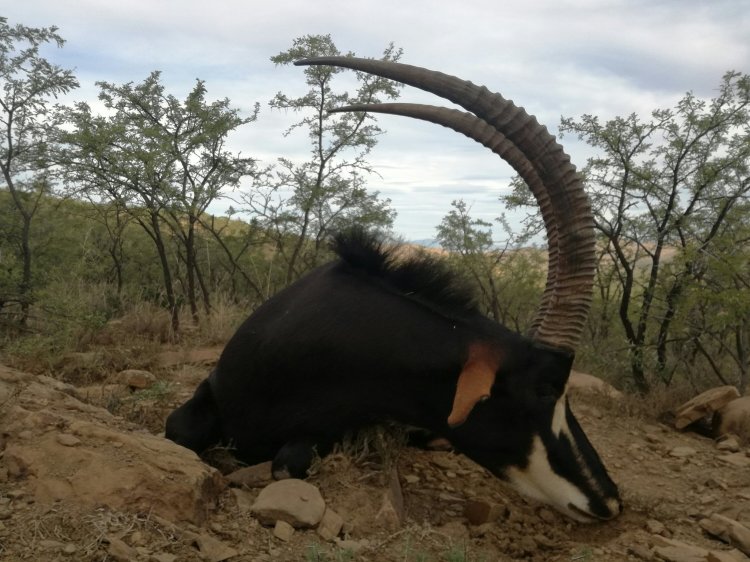
How far can you shoot?
There is always the debate over whose type of hunting is better. In the end we are all hunting and as long as it legal we should not criticize another as we have enough anti hunters to deal with.
Some people try the traditional muzzle loader while others use a bow and arrow. I like to get in as close as I can but then there are those who want to test their marksmanship skills at making kills at a distance.
I know of one such man and he has spent many hours putting bullets down range to fine tune his skills. He has some very nice equipment too. Shooting a Ruger precision rifle chambered in 308 win mag. His chosen ammo is Hornady 168grain interlocks and he has a very nice tactical long range Steiner M5 Xi scope sat on the top. For him, this all works very well.
He is quite happy to sit or to be more honest lay down for the day shooting gongs at distances of 300-600 meters just to feel comfortable with a shot if it presents its self in the field. At home in Switzerland, he practises consistently at the range which is in a tunnel into a mountain. Unfortunately there is no wind to take into consideration there which is very different from being out in the Eastern Cape of South Africa. Due to this a gong range was set up for him on the property he hunts here, so now he has all the elements to contend with. Putting his skills to the test, which he is getting right.
On previous visits he has taken species such as steenbok (Raphicerus campsestris), common duiker (Sylvicapra grimmia), impala (Philantomba monticola), red hartebeest (Alcelaphus buselaphus), blue wildebeest (Connochaetes taurinus) and black wildebeest (Connocheates gnou) as well as springbuck (Antidorcas marsupialis). Despatching them cleanly.
On this particular trip his intended quarry varied from impala to waterbuck. All of which were for management purposes. This meaning old animals which had past their prime or animals which we considered to have inferior genetics and should therefore be taken out of the breeding population.
The impala rut had started so rams could be heard through the night grunting away. Making us all believe that the first mornings hunt would be a push over. We woke and breakfasted at 07:00 and then started our search. There were some rams about but certainly not the ones which fell under the category of management animals. We searched high and low but nothing. Finally we headed to a quiet area where nobody really goes due to the difficulty in trying to recover any animal shot. It is a small open area surrounded by shear cliffs and a dry river bed meandering through it. There are a few trees but not many. The distance is about 500 meters from one side to the other making it a perfect place to try out our long range equipment.
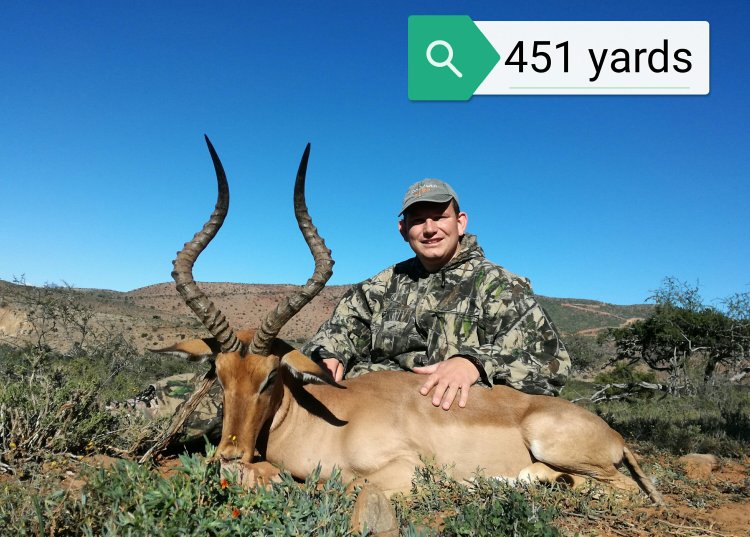
We sat at the edge of one of the high ridges from where we could see what was going on in the bowl. Nothing. Then all of a sudden at the far end out walked an impala ram. I would shoot him with any client but looking at the shape of his horns he was one for the long range man. He was a fully grown mature ram. His horns were open at the top but the shape made an hour glass type of a shape. He stood at the far end of the bowl making for a testing shot. The wind was pumping but we had the advantage. He then realised that there was something wrong and started moving around. Eventually he went and stood under a small tree. Facing straight towards us so not giving much of a target zone. My client got himself ready. Not able to lie down he had to sit and lengthen his bipod. They didn’t lengthen that much as normally only used when lying down. I took a steady hold on the animal with the cross of my rangefinder and pressed the button. The reading came up in red, 451 yards. I said out loud that this was going to make one hell of a shot if he pulled it off. Asking if it was ok to shoot I told him he could shoot whenever he felt comfortable. He quickly made the calculation and dialled his scope up. Aiming for the front on chest shot he said he was ready. After a moment his breathing steadied and the shot went off. Keeping a watch on the animal through my 10×42 Steiner binoculars I saw the bullets vortex. WHACK. The ram dropped on the spot. Not even moving afterwards.
We watched for a second and then readied for the descent. We reached the bottom of the cliff where the talking started. Both still getting over the shot and wandering where the bullet had struck. Getting to the lifeless body lying under the tree we noticed the small drop of blood on the front where the crosshairs had been placed. The shot had been perfect. Hitting the ram exactly where intended. It had exited out of the far rib cage showing there was a slight quartering towards angle. Looking at the information the bullet took just over half a second to reach its intended target and dropped around 1.2meters. The shot had been made many times before on the range but this was the real deal.
Helped by the technology provided in today’s modern hunting equipment and many hours of range time, we were successful.
We are now off to look for another quarry which may or may not be as impressive a shot but the chain has been broken and we know what is possible, if you put the hard work in.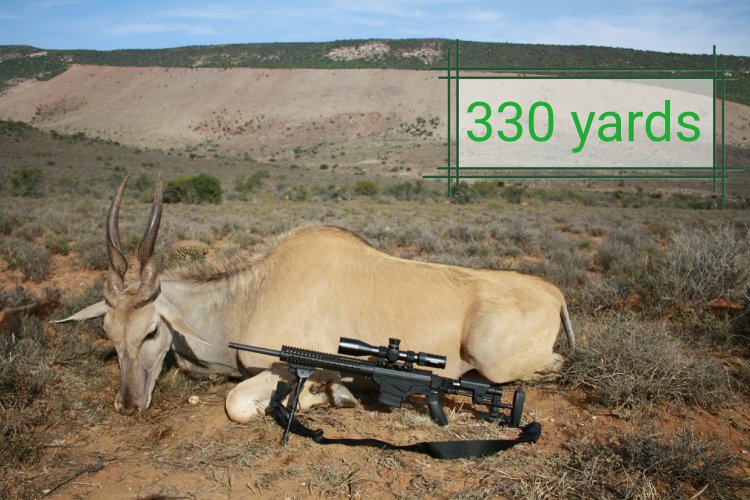
Bushman cave paintings
It’s not always what you shoot on a safari which is the highlight. Sometimes it’s what you find.
My greatest find was something I regard to be my best hunting experience ever. It wasn’t a 50 inch kudu (Tragelaphus strepsiceros) bull or a super hard old buffalo (Syncerus caffer) but a wall of history and stories.
I was on a hunt with a very nice young policeman and his wife from Ohio in the USA. We had successfully hunted a number of animals including springbuck (Antidorcas marsupialis), blesbok (Damaliscus pygargus) and a few others.
We were now looking for the one animal which most have on their wish list in the Eastern Cape and the one animal you are hunting from the start of the safari until you get him. You may be stalking in on something else but this elusive animal takes preference if spotted. It is the Eastern Cape Kudu. With his dark, thick neck and a set of impressive spiral horns it is always a happy day when one is harvested.
They hide away in some of the most impenetrable places and often only come out in the late evening.
We were hunting not far from a town called Graaff Reinet which is the fourth oldest town in South Africa. This area has varying terrain from open savannas to high mountains. On this particular occasion we had decided to hunt the mountains.
We had left camp early driving up the rough track of the mountain. The plan was to drive to good viewing areas and stop and spot for the bulls. We saw herds of cows and young bulls but nothing which was worth stalking in on. The rut had just started so we knew that there would be big bulls near the cows. So we kept on with our plan and kept glassing the mountains.
After a lunch of steenbok fillets marinated in honey and a couple of spices quickly grilled over the coals of some acacia wood we headed off again.
Looking up into the deep valleys searching for the illusive bull. Then a tap on the roof of the vehicle. My tracker had seen a bull high up just above the tree line. I looked at him through my binoculars and decided he was worth closer investigation.
Myself and my client climbed out and put a plan together. We would have to climb using the contours of the mountain to hide our approach from the bull. We headed off using game paths to get ourselves into a position for a shot. We got to about 250 meters and we decided between us this was as close as we could get without being spotted. My client readied his 308 rifle on a rock and fired. A miss. He quickly reloaded and fired again as the bull was unaware of our location he had not run. The second shot was a hit. Not a perfect hit but he went down. We knew we had to climb up higher to be above him for another shot.
We looked up and planned that we would have to get to an overhang above us to get another shot. This is when it happened.
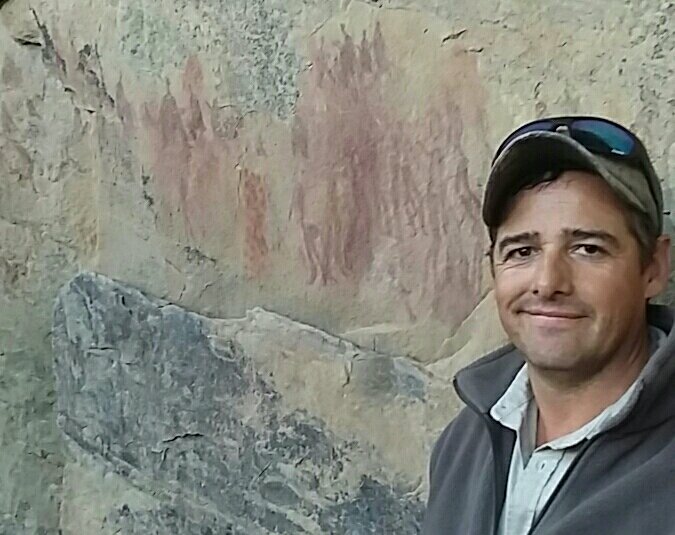
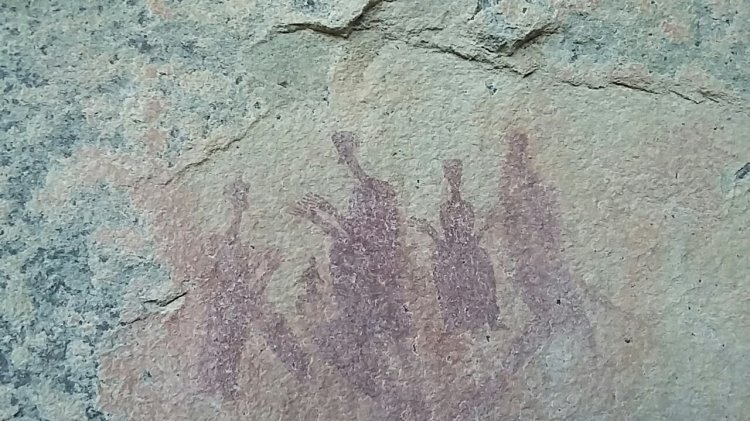
As we came out of the bushes by the overhang I suddenly noticed something very special. The wall which we faced was covered in art. I got goose bumps and I felt the hair on the back of my neck stand up. Not any old art but pictures telling stories from a time long before the European discoverers had arrived in South Africa. Mystical portraits of happenings of the past. No animals which are often seen but just of people. People sitting, standing as if in trance. The details had lasted hundreds of years.
Then my young hunter brought me out of my own trance by asking when we were going to get his kudu. I quickly pointed out to him what he was looking at and that this was a much greater find than his kudu bull. I did understand his desire to get his bull though.
We climbed slightly higher to a spot where we could see the bull lying with his head still up and a good neck shot was put in to despatch him. The team arrived up the mountain to recover him and during this time I inquired if anyone knew of the magical spot I had found.
Nobody knew what I was talking about. Not even the owner of the ground whose family has been farming that area for five generations. He did not believe me until he himself headed up the mountain and saw it for himself.
I have no idea what the paintings mean and everyone sees something different when they look at the wall. I believe it was a meeting place where shamans did their magical work of speaking to the Gods which they worshipped.
This was a special day for me in my outdoor life and I am not sure whether it will ever be match and to be honest I am not sure if I want it to be. I have visited the site a couple of times since then with clients and all see it as a magical experience.
It just shows that the more you spend outdoors the more your life will be enriched by nature and maybe, just maybe you can find something that means as much to you as this special find means to me.
 Hunting and Outdoor Adventures