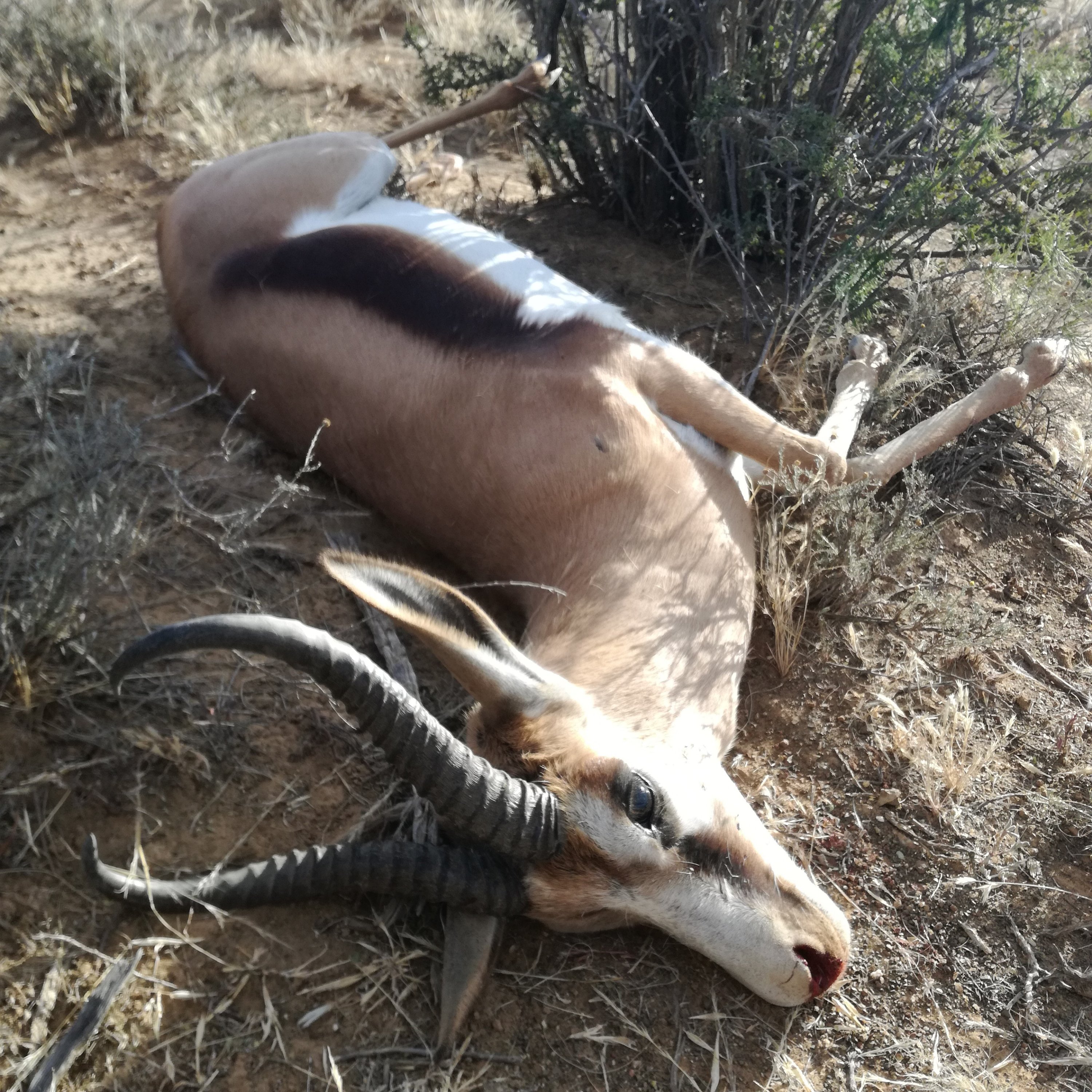
Black backed jackal in the lambing camp.

As some of you may have read in a previous story I wrote about a friend of mine who was losing lambs to a predator at night. Which we eventually caught up with and killed. They turned out to be caracal which are amazing animals but can cause huge problems to a stock farmer, especially if they get a taste for lamb.

At tennis one Sunday afternoon the farmer friend of mine told me he was once again losing lambs. A couple every few days. Others were also bitted but not killed. The bite marks were around the back end and quite sever but these lambs would make it with a bit of doctoring.

This was different than before. A caracal bites at the throat to kill and then eats the choice cuts at the back. The dead lambs he had found were very untidy, with the stomach opened and spread around the carcass.

The culprit was not a caracal but jackal this time. Part of the dog family and weighing in between 6-13kgs. They are incredibly intelligent and cunning. Wearing one of the prettiest skins there is to find. With all of this in mind they are also incredible hunters. Either hunting alone or as part of a pack. Males and females will hunt as a pair killing animals much heavier then themselves. They have also been found in larger packs where they harass and wear down an animal until they overpower it.

We arranged on the tennis court that we would have to get out as soon as we could, as these killings would not stop.

The following day I got the shooting chair on the back of my vehicle and prepared the rest of my equipment.

This time there would be a couple of changes in my kit. The spotlights would be the same light force which I always use and the caller would be the same FoxPro. The differences would be the ammunition and the scope on top of my trusty Howa 308win.

The bullet change is still made by the same company, Kriek. The difference in the previous bullet and the new one is quite significant. The previous one was a 155gn copper monolithic hollow point. Designed to stay together which is perfect as a hunting round. This time I have changed to a specially designed varmint bullet. This bullet is the same weight as the hunting bullet but made from brass and a very different design. The Havoc as it is known is designed to cause maximum damage. The petals at the front of the bullet fragment and fly around inside the quarry causing huge damage. The shank at the back continues through either exiting on the other side or giving good penetration into the body.

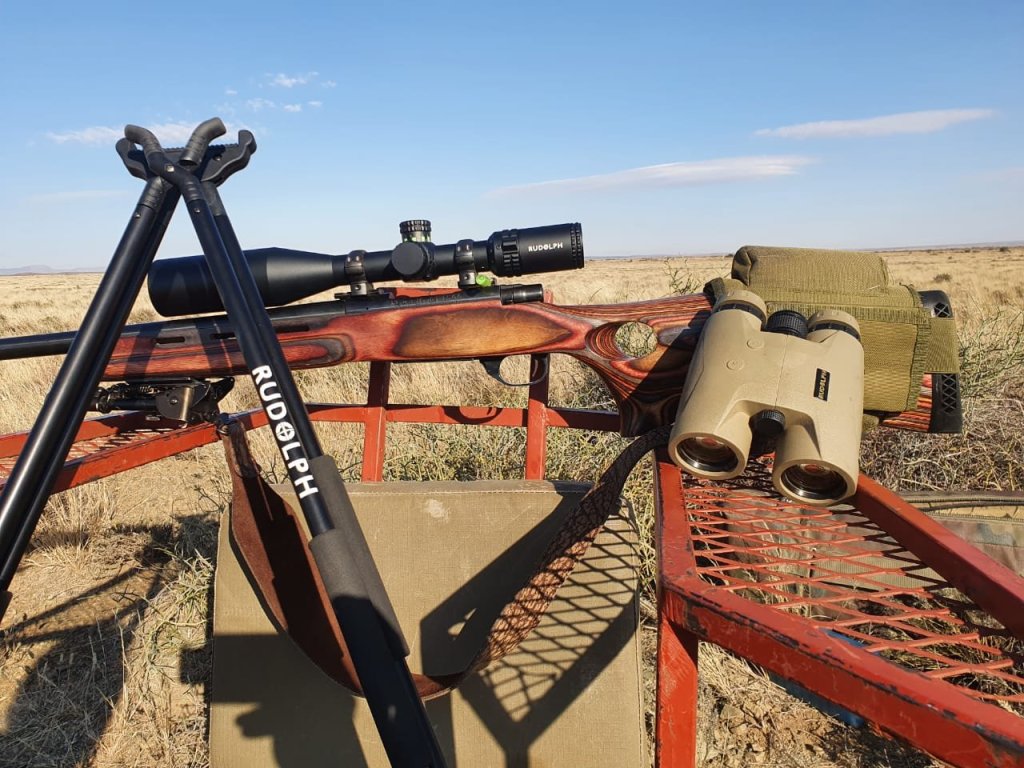
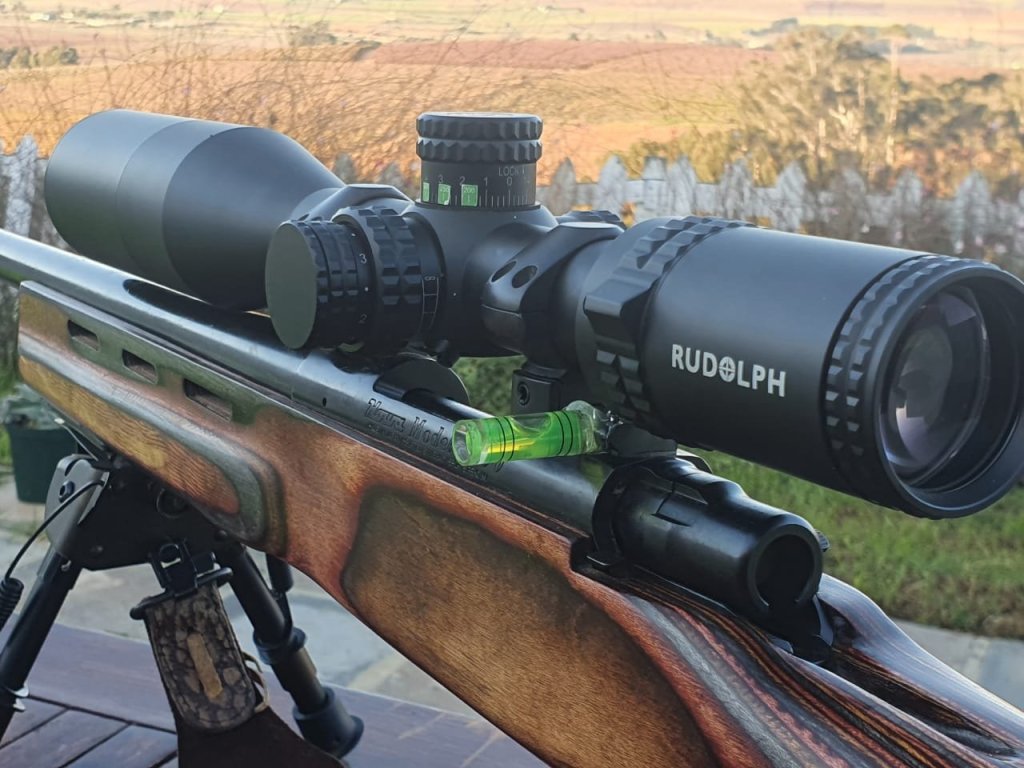
The other change to my equipment is my scope. My new optics are made by Rudolph Optics. The previous scope was a 3-9×40, and I found that I wasn’t getting enough light into my scope at night, limiting my ability to identify quarry at distance in the dark. Due to this I made the change. I put on a V1 2.5-15x50mm with a D2 illuminated reticule. This would give me a much better low light scope enabling me to get better success in the dark. This scope also has the tactical turrets so you can dial up and put the cross hairs on the required point of impact. To me this is one of the best value scopes on the market for the price and competes with others which have a heftier price tag. Well worth looking at if you are in the market for some new glass for the top of your rifle.

At about 18:00 I started my trip up the road to my friend’s farm. He would be driving for me and as he still had farm work the following day I guessed I had until about midnight to try to sort out the problem. On arrival we sat and had a coffee and discussed what the plan would be. 

We would leave after dark and head down to where the sheep are getting taken. I would then call and see what we see, if  nothing came in then we would drive and see if we could pick them up on their to the sheep. 

Looking out of the window I could see the time had come. Complete darkness. There was no moon and the only lights in the sky were the millions of stars. Many of which were shooting stars as we found out later it was the height of a meteor shower.

We headed out and I climbed up on to my seat on the back and Graham jumped into the front. As we drove to the first spot I swung the light around looking for eye shine. Lots of kudu and small night animals but no jackal.

On arrival in the lambing camp I walked out about 80 meters at placed the FoxPro next to a bush. Waiting for about 10 minutes I put on my first call. A distressed rabbit which I had had good results from. Spinning the chair and scanning for eyes every now and then but nothing. We continued in this spot for about half an hour but no success. We moved on and headed to the area we had had success in the past but nothing. We didn’t even see eyes of our chosen quarry. Lots of bat eared foxes which don’t cause any damage and good numbers of kudu but that was it.

Looking at my watch I saw it was just after midnight. After having a quick chat with Graham we decided we’d start on our way back to the farmhouse but passing the lambing area again on route. 

As we approached the main road through the farm which runs along the lambing camp I spotted a set of eyes. I quickly flashed the light over the front of the vehicle, which is a common indication to stop. The vehicle quickly stopped and I swung the chair around for my rifle to be pointed in the right direction. Finding the eyes again with the spotlight I looked through the scope. Perfectly clear as day, there was a jackal trotting from the lambing camp side towards the bush area. With the illuminated red dot in the middle of my cross hairs placed on the moving jackal I gave a bark to stop it for a moment. They often stop and give you a second as they are inquisitive about the noise. As it stopped I squeezed the trigger. The unmistakable sound of a hit. The thud which every hunter has heard came back to us. 

Graham quickly asked what it was and I said it was a Jackal. We drove closer and climbed off to go a retrieve it. A mature female in good condition lay dead where she had stood. I had a happy farmer with me now who was encouraged to keep going. We got back to the vehicle and started to drive again. Within a couple of hundred meters and in the lambing camp I saw another set of eyes. Quickly flashing again the vehicle stopped. This one was further away, about 180 meters but through the scope it was clear. Again I had to bark to stop it which it did and as soon as it did I fired. I heard the thud but Graham didn’t and questioned if I’d hit. We walked over and climbed over into the lambing camp. I remembered a specific tree where the jackal had stood in front of and there it was. Laying stone dead in the spot I had seen through my scope. This time it was a big male. The partner of the female shot minutes before no doubt.

The equipment had worked perfectly. I was very happy with the results from my new bullets as they had done exactly what I needed. Dead animal where I shot it and no need to search for a runner. The scope had excelled and made night shooting so much easier.

We also had a very happy farmer and a safe flock of sheep for now for now. I am sure I will be out there again as soon as another predator moves in to fine dine of his great tasting Karoo lambs. 

TAKING ADVANTAGE OF THE SITUATION

The season had been long underway and we still had a few kudu to take off the property to meet our quota. 

It is a low fenced free range area where the owner surveys how many kudu are regularly on the property and then calculates how many he will take off. These will be divided up between mature bulls, old cows and bulls which are showing bad quality horns. 

We had done well through the season to date with some magnificent trophy bulls being taken and a number of old cows. Some of which had worn their teeth down to the gums and would definitely not make it through another winter. 

We still had a couple more cows to harvest and a plan was put in place. A herd was regularly seen coming out of a valley late in the afternoon. In this herd there looked like there were a number of suitable animals to take.

On this we decided to get out early in the morning to hopefully ambush them on their return from feeding in the flats during the night. 

We arranged to meet at the farm before sunrise and walk from there up the mountain behind the homestead and wait there for our quarry to come to us.

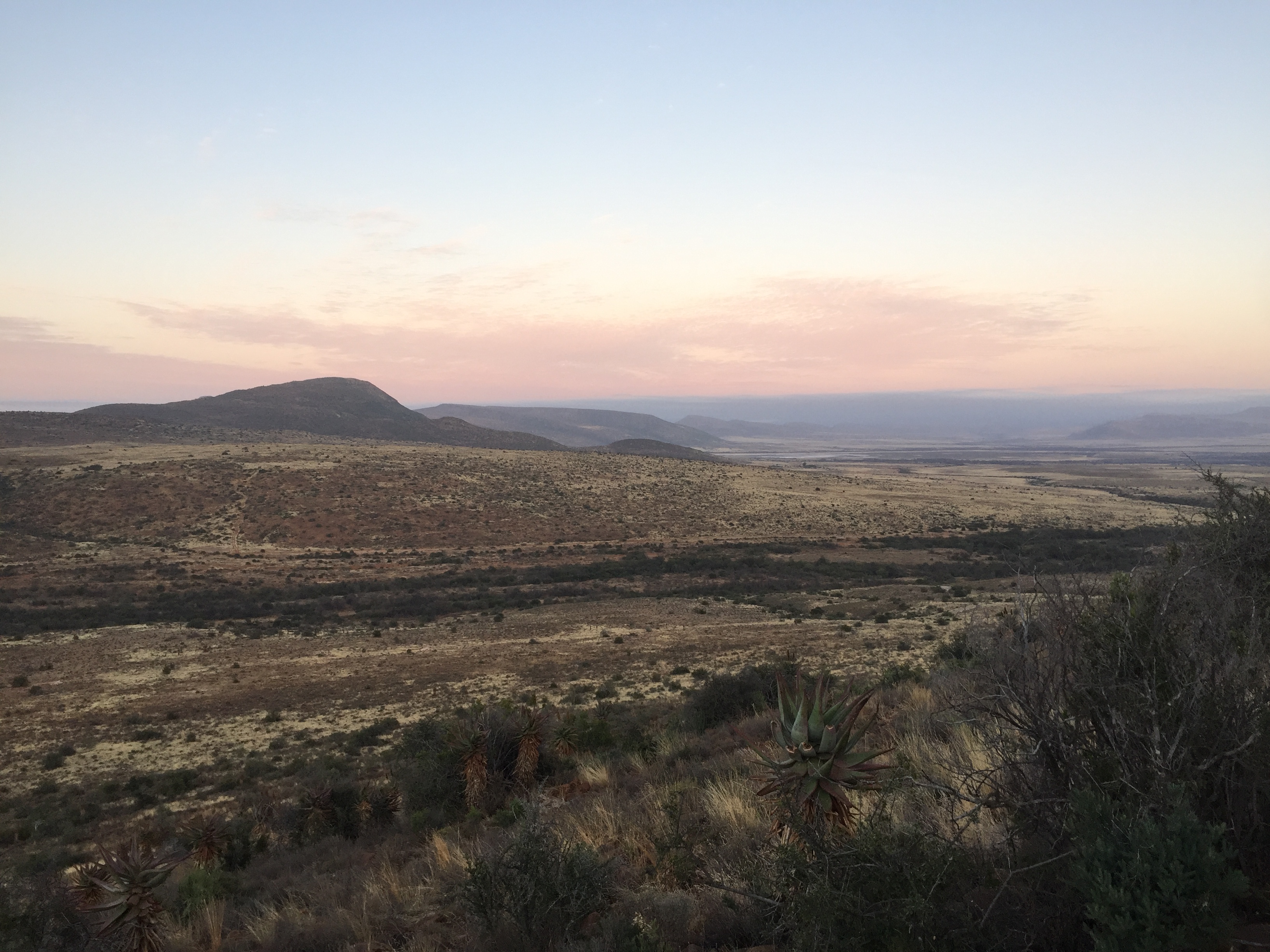
My alarm went off at 04:30 and I made my way to the farm. By 05:30 we had made our way up the mountain and Will and I sat by an aloe, admiring a sky lit up by the millions of stars unspoilt by modern day light pollution. 

As the sun started to break through and light up the sky we looked through our binoculars down onto the flats in search for the movement of kudu below. Soon the sun had risen and nothing had appeared.

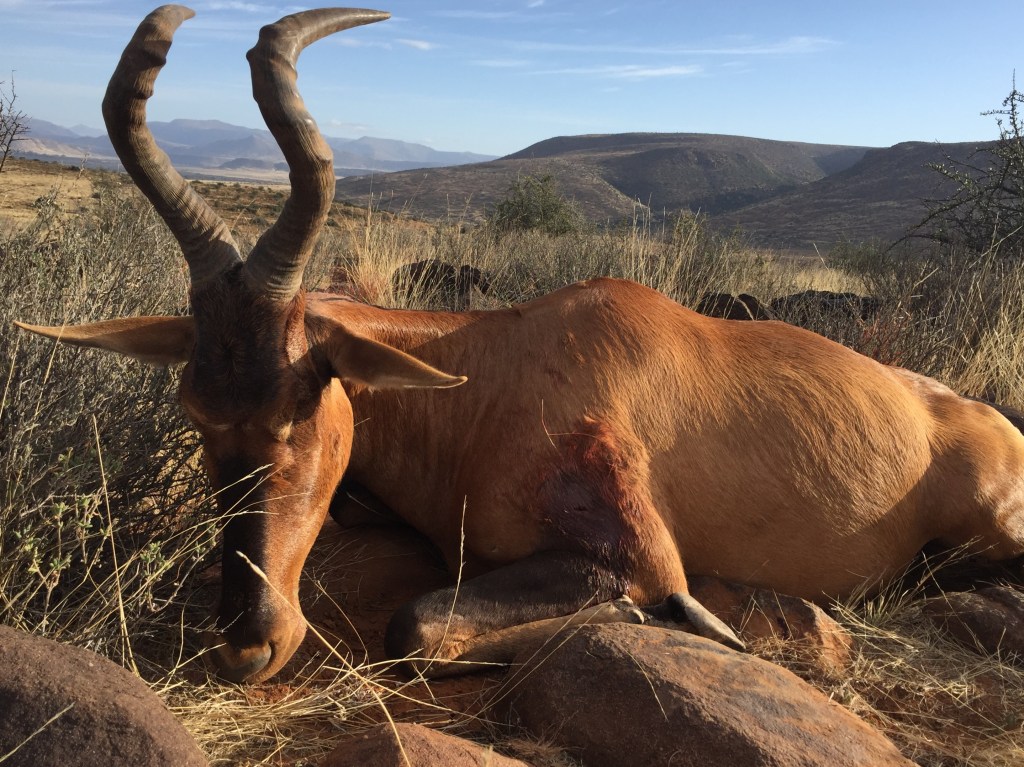
Scanning the river bush below there was nothing. Raising my binoculars and scanning the ridges on the other side of the valley I noticed a lone red hartebeest. We knew of one which had been resident in the area for some time and had been causing quite a lot of damage to the stock fences on the farm. Breaking strands when moving from one area to the next.

It would be quite a stalk to get in on it but we decided that if Will stayed in our present position and I moved down he would stay in communication with me over hand held radios to guide me in. We looked down over the area which I would have to cover to get into a shooting position. We worked out even though it was a long way off I would have to carefully and slowly make my way down to the river bed where I would be out of site from the hartebeest. Once there I could go as quickly as I could before climbing out the other side for my final stalk. It would be quite open on the final section, so I would have to use the contours of the land. During this time I would be in full communications with Will to walk me in and alter plans if the hartebeest moved to a different spot.

I started my way down and at about 100 meters from Will I checked the radios were fine. All was good and we both sensed a great stalk ahead. Not long after this I heard movement behind me on the ridge. Looking back towards where I had come from I could see the herd of kudu we had been waiting for. We had reacted too early. If we had waited for five more minutes our initial plan would have worked perfectly. I quickly called Will and he said to continue on with the new plan as it was an animal we needed to harvest due to the fence damage.

I turned and continued down to the out of site river bed where I speeded up pace as I knew I was clear from view. Using a lone tree on the hill side as a marker I started my ascent. 

A touch of static on my radio which was turned down low brought me to a halt. Taking it out of my pocket I quietly called Will to see if he was trying to get hold of me. He said in a whisper that the hartebeest was still in the same area and was slowly grazing away from me so it was looking good.

The sun had now risen above the mountain behind me and I could see my shadow stretching out in front of me. Suddenly I felt one of a hunters worst feelings. The breeze on the back of my neck. It had completely changed direction and drastic measures would have to be put in place and quickly. Otherwise this stalk was over.

I quickly spoke to Will and told him the situation. I slowly moved back down the ridge and headed to the along towards the East. It would mean that I would have to do a big circle around and come in from the other side which would also mean that for part of the time I would probably loose communication with Will. 

I worked out where I would have to get to and made my way. As I approached where I thought the hartebeest should be, shading my eyes from the now bright sunlight Will came back into signal. 

I heard him say that the animal was not far from me but looking directly in my direction. There was no ways it could have seen or smelt me but as with all wild animals their sixth sense is amazing and is often the reason they grow to old age.

I crouched low and peered around an aloe to see if I could see it. There it was, about eighty meters from me standing as if on attention staring straight at me. I slowly positioned my shooting sticks and glanced away for a second. When I raised my eyes again there was nothing. The hartebeest had gone. 

Will quickly came on the radio saying that the hartebeest had trotted up and over a ridge to my right. I slowly moved in that direction hoping at any moment to see it but nothing. Then I saw it. About 500 meters away looking back in my direction. I had to keep going for it as the kudu were already gone and we needed meat for the farm. As the staff rations had finished.

I cut down to my left keeping the ridge between myself and the hartebeest and hooping to close the gap  before it headed to another area. After covering a couple of hundred meters I reached a farm track and there only about 200 meters from me standing facing me was the hartebeest.

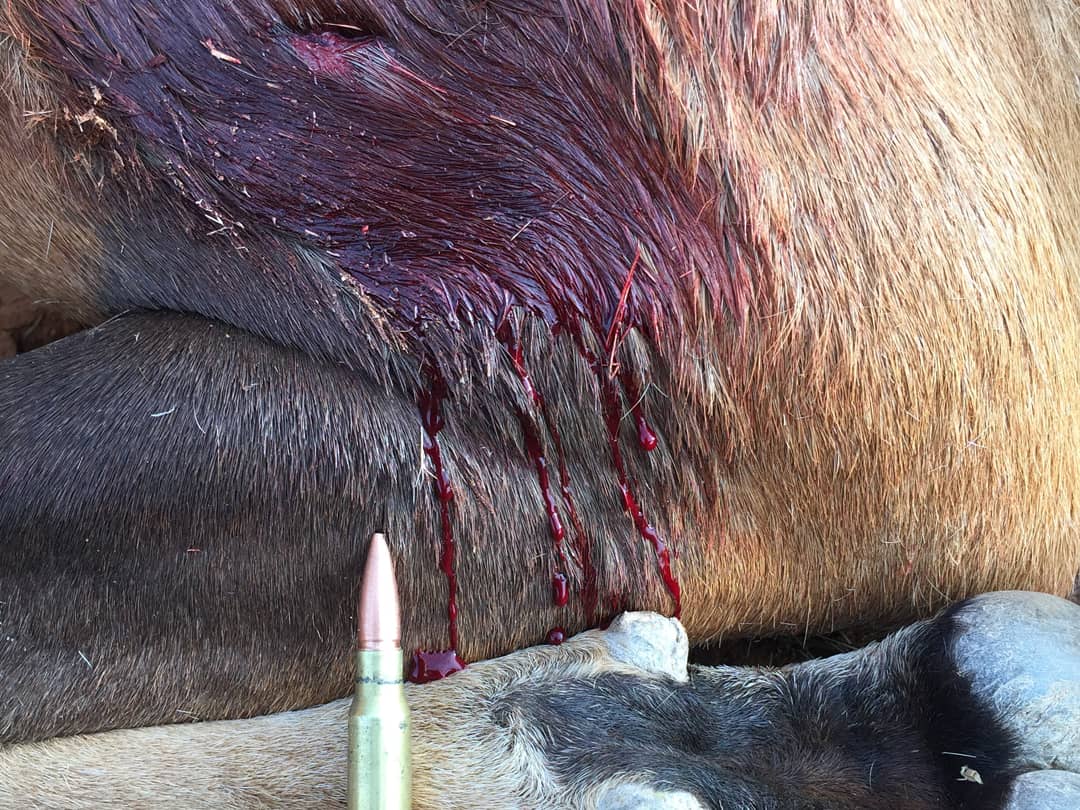
I lay down on the road and extended my bipod. Making myself comfortable I found the hartebeest in my scope. It slowly turned broadside and walked a little but then stopped to look back at me. As if unsure what I was. I pushed the safety catch off on my Howa 308 and began to squeeze the trigger. The shot went off and the hartebeest jumped after being hit by the 155 grain Kriek monolithic hollow point. Through the scope I could see some blood on the side of the animal but it was not going down. Slowly walking away from me. 

I got up and moved quickly towards it keeping some bushes between us as cover. As I got to an opening in the cover I saw that I had actually got in front of it and could see it slowly walking parallel to me. I lengthened my shooting sticks and waited. As the animal came in front of me I whistled. It stopped and I fired, hitting it directly on the shoulder and knocking it down.

I radioed Will and said it was down where he replied that he knew as he had been watching the whole thing from his view point. He would head down to get the vehicle and come up to help get it out.

I walked up to check on why it had not gone down with the first shot and found I had been a little far back with the first shot.

It turned out to be an old cow which was well past breeding and her teeth were well worn down. The perfect animal to have taken out.

Her meat would be used for the staff on the farm as rations and the skin would be sent to Karoo Taxidermy for tanning, where it would eventually be a rug on the floor in one of the guest cottages on the farm.

SOMETIMES THE TAME BECOME WILD

Over the years I have hunted many species of wild game. 

On some occasions I get asked to shoot something different. These hunts don’t include the typical game species, but involve domestic stock that have gone wild.

Due to the remoteness of the farms in the area I live in it is difficult to gather all the animals every time you try. Because of this some have very little contact with humans and over time become more uncontrollable. Eventually becoming as wild as the kudu and other game species in the area.

I have had sheep, which have escaped and become part of a blesbuck herd, acting in exactly the same way. Retreating to the high ground when approached by people. The same has happened where they have joined a herd of zebra too.

On this particular occasion the domesticated animal is cattle. They did not joined other species like the sheep did, but just made small herds and remain in the deep valleys away from any human contact. 

We first saw the wild cattle whilst hunting a waterbuck, which was in a previous blog. We saw a herd of eight animals which the farmer announced to us were wild and had run there for many years. In the evening of that hunt he offered it to me that they should be shot, as they could never be gathered with the other herd. I said I would see what I could do, but it may take some serious planning.

The following week I contacted him and said I was going to see if I could get in on one of them for a shot as I had a couple of people interested in the grass-fed, organic beef.

He said I was welcome to visit and he would inform the two staff members I would be coming. The plan would be to try to herd them with horses to an area where I could hide away. I would wait for them and aim for a head shot so that we could recover them easily with the vehicle. However, the cattle had other plans! On first glimpse of the horses the cattle headed through the stock fence and down into the deep canyons.

A new plan would have to be devised.

The following week the farmer phoned me to tell me that the staff had come up with a plan. They would move them into another area, which they believed would work better.

I arrived on the farm ready to see where we would be heading to. The staff were waiting and told me that they had been keeping a track of the cattle to see which way they moved in and out of the canyon. They also told me that the original figure of eight was now eighteen. Just goes to show how illusive they can be. 

I was to wait in the one spot at the top of a ridge overlooking the canyon and the staff would circle around behind them in the hope that the cattle would try escape in my direction. Giving me the opportunity of a shot as they passed on their escape.

I chose a decent sized bush to sit under while the guys headed off in their designated directions. With good visuals into the canyon I would be able to manoeuvre into a good spot well in advance of them reaching the high ground. 

Looking through my binoculars I saw duiker and kudu below me going about their daily business oblivious to me observing them from my vantage point. I find it very relaxing to watch over areas like this and learn the habits of the game to aid me in future hunts for them. Both the duiker and the kudu were very aware of their surroundings and constantly stopped to listen and smell the air for any signs of danger.

Suddenly both animals stopped and looked down the canyon. They could obviously hear something. Then they moved into the thick undergrowth and were gone, not to re-emerge into view again.

A few minutes later over the top of the mountain on the opposite side of the canyon a herd of nine cattle appeared. Heading away with a determined speed. Not stopping for anything as I watched them. Fences were jumped and from my view point they did not stop running while in view, which was at least two kilometres away. 

But where were the others? Suddenly down in the canyon I saw a flash of white going behind a bush. Out of nowhere they appeared crossing an open section. Through my binoculars I counted them. Nine cattle. Five large animals which I guessed to be around the 400kg mark and four younger ones possibly weighing in around 200kg.

My only thought now was that I should stay out of site but keep them in view hoping they would continue up the side of the canyon to the ambush site. 

Suddenly they were gone. They had crossed the river underneath me and vanished. I moved quickly along in the same direction trying to relocate them, but nothing.

Then all of a sudden and to my horror there they were. They had stuck to the plan and were coming straight up as expected. The next problem was that I was too exposed. I moved quickly away from them keeping as low as possible in the hope I would reach the bush line before they saw me. Reaching the bush line I looked back to see them still heading up. I sighed with relief. 

I quickly worked out where I had to get to for a shot and moved briskly to a small tree. As I reached it the first beast appeared. A big black cow boasting an impressive set of horns. Getting my rifle onto the shooting sticks I picked her up in the scope. As she went passed me at about sixty yards I realised she was not going to stop and I would have to chance my luck on a moving head shot. Moving the cross hairs to her head I waited for her to be slightly passed me, giving me a shot behind the ear. I squeezed the trigger and she collapsed in the run. The others startled and ran passed her not giving me another chance of a shot.

As they ran I scanned through them and chose my next target if they gave me the opportunity. At about one hundred and sixty yards they stopped as if waiting for their companion to join them. This was my chance. I extended the bipod on my rifle and steadied over a rock. The cow I had chosen earlier stood facing away, also giving me that preferred shot of behind the ear. I steadied the cross hairs again and squeezed. She dropped on the spot while the others charged away to higher ground leaving their fallen comrades behind.

The staff suddenly arrived and the field preparations began. As is usual in Africa, nothing is wasted. The animals were quickly gutted and everything bagged for later consumption. I brought the vehicle, and with the help of the staff and my winch the two animals were loaded without any issues.

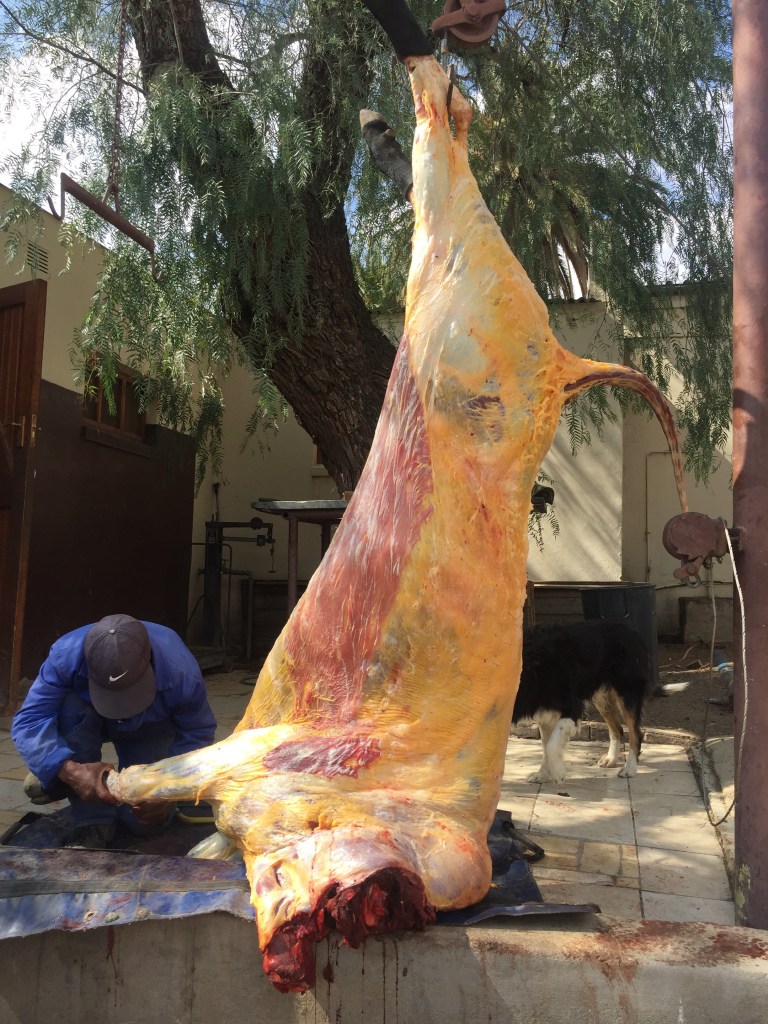
We drove back to the farm house, which took about an hour with the mountainous dirt tracks.  We skinned the carcasses and they were ready to be taken into town. Within two hours we had both cows in the cold room with instructions being forwarded on what the buyers required. One wanted biltong (jerky) and the other was to be butchered for the table. So steaks, mince and all the other delicious cuts would be done.

This ended very successfully with everyone involved being winners and now it is time to start planning the next trip, which I hope ends just as successfully for us all. (Except for the cows that were shot)

A forty year old challenge accepted and achieved.

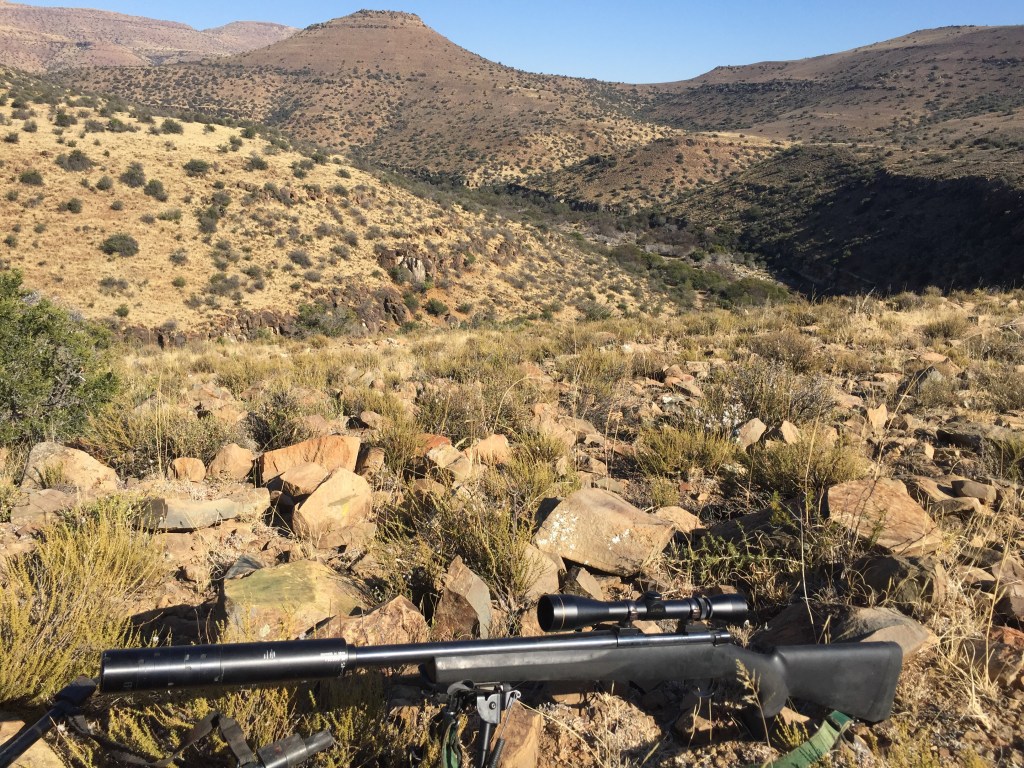
The warning was said over forty years ago. Hunters and land owners cautioned: “Don’t shoot anything there, as we’ll never be able to recover it”.

Kudu and waterbuck are the main species which inhabit that specific property along with a few springbuck and mountain reedbuck. 

The terrain is tough. High mountains with deep valleys, many of which are almost impossible to navigate through due to the waterfalls and cliffs. The mountains are mainly grass covered and open but recovery of any animal would certainly require a climb through one of the valleys. Vehicle access is solely along one of the few dirt roads running through the property. Rough and rocky with a number of river crossings along the way. Leaving these roads is pretty much impossible due to the rocks and boulders, which makes the words of the past hunters quite understandable.

Nevertheless the challenge was still there and had not faded over the years. 

One day while watching one of the many hunting shows an idea was born. Many of the hunters in the USA who hunt big game such as elk or moose have to pack their meat out once it has been shot. Either by horse, or by packing it out on your back in backpacks.

He thought to himself that he has both horses and backpacks so why can’t we do exactly the same here. This may be the perfect opportunity to show the now old timers that it can be done.

The team of hunters would have to be selected carefully as it would not be an easy task if it was a successful hunt. 

Six hunters were chosen, surprisingly it was almost the same group of us who had hunted a couple of years previously where two very nice kudu were harvested. The only change was one chap out due to his wife expecting their first born. He would be replaced by a young man whose passion is to hunt with a bow but this time he would have to trade in for a 338wm.

We would spend two and a half days hunting for either kudu bulls or waterbuck. We would stay in a recently renovated farm house on the property so that we could be up and out early in the morning. 

The first afternoon would be spent scouting to see where suitable animals could be found. We saw a number of kudu as we glassed, which made everyone excited about the following day but it also showed us the terrain in which we would be hunting. 

That evening we sat and discussed the plan for the following day over a few glasses of wine and a fine meal prepared by one of the team members who happens to be a chef. Always a good thing when a hunting buddy is a chef as you know the food will be good and the end of each day.

We were split into four teams. 

Myself and my long time Scottish hunting buddy would go together. We would make our way down a deep valley which emerged at the main river where we would meet the rest of the team. The second team would work the main riverbed. The third team comprised of the new young hunter and a staff member who would go up over the high ground and the fourth was the owner who would oversee everything and have the horses prepared just in case one of us was lucky.

The following morning came and we headed in our designated directions. 

Will and I slowly made our way down the deep valley. Trying to keep as high as possible giving us good visibility below us. We saw a young kudu bull which we let go knowing there would be better and to also give him a chance to grow out for future years. Eventually we made it to the bottom and met with our host. Nobody else had seen a shootable animal yet but we still had time. 

Noticeably we were one short in the group. Our new companion was absent. We discussed his whereabouts and came to the conclusion he would be fine.

Then all of a sudden as if he knew we were talking about him he called on the radio.

‘Waterbuck down”.

We all stood listening in anticipation to find out where he had got him. We quickly realised that it was in one of those areas where many years before everyone was told not to shoot in.

Our hearts did not sink with the thought of a dreadful recovery, and we were all surprisingly jovial as this was the aim of the game. We wanted to prove the past wrong by recovering something, which previously would have got you scolded.

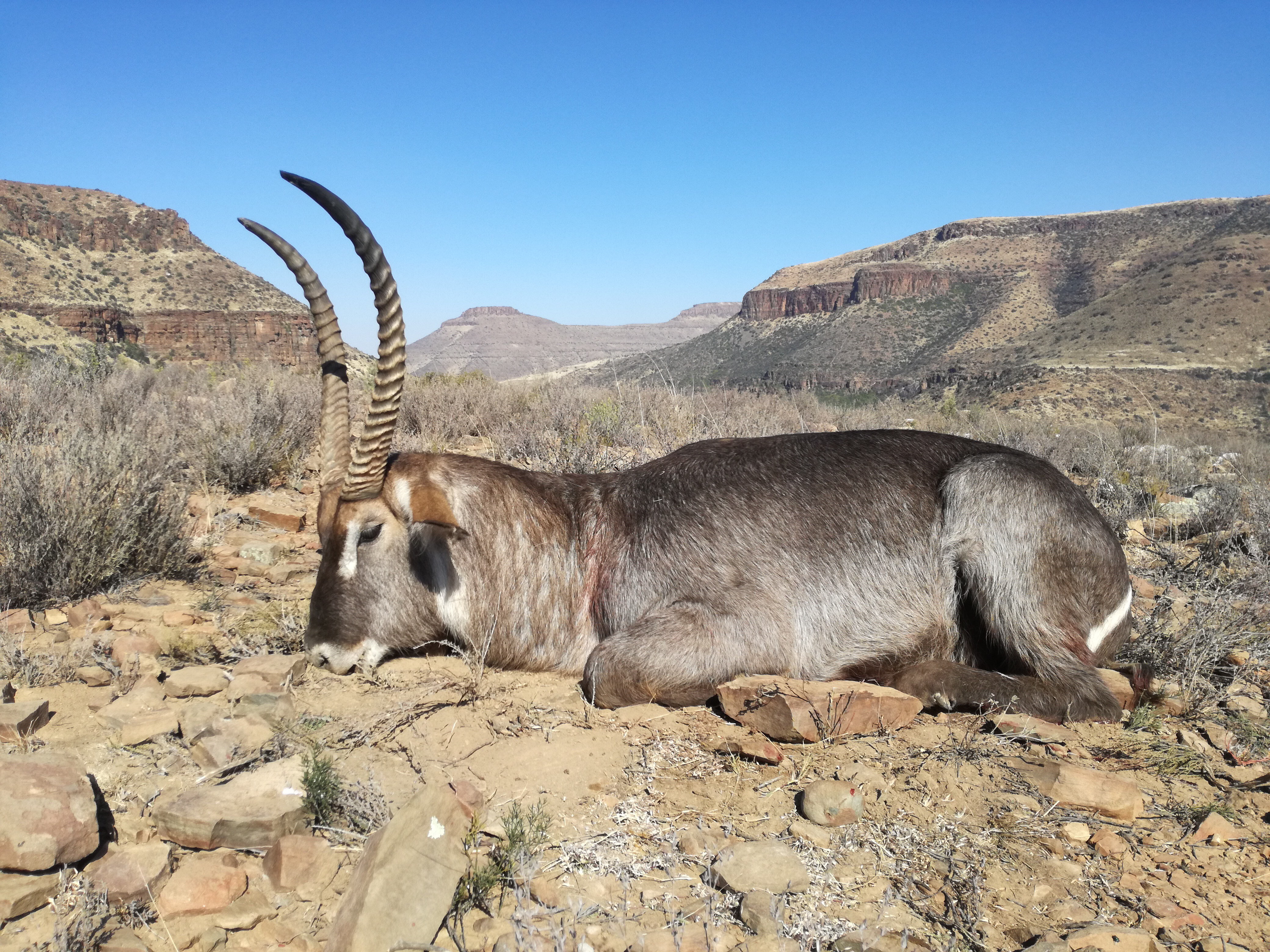
We prepared ourselves and headed down into the gorge before climbing up to a very happy young man with a beautiful old trophy waterbuck bull. Well past his prime and living his days out alone on the top of a mountain.

Photographs were taken and the stalk discussed. A perfect stalk followed by a perfect shot had produced the perfect challenge for a recovery.

We decided it was too late to go a get the horses so we would cut the bull into sections and come back in the morning to recover him. This would also give us the opportunity to put another theory to the test, which is that waterbuck tastes dreadful if you allow the hair to come in contact with the carcass. This is due to the oils on the hair spoiling the taste of the meat. 

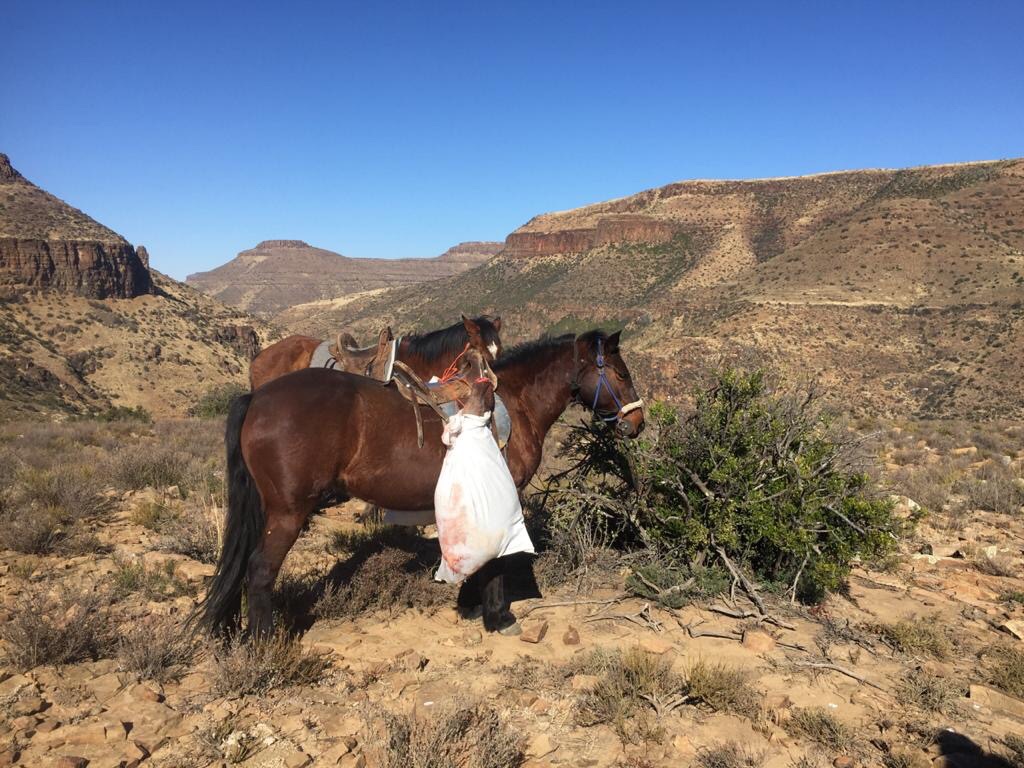
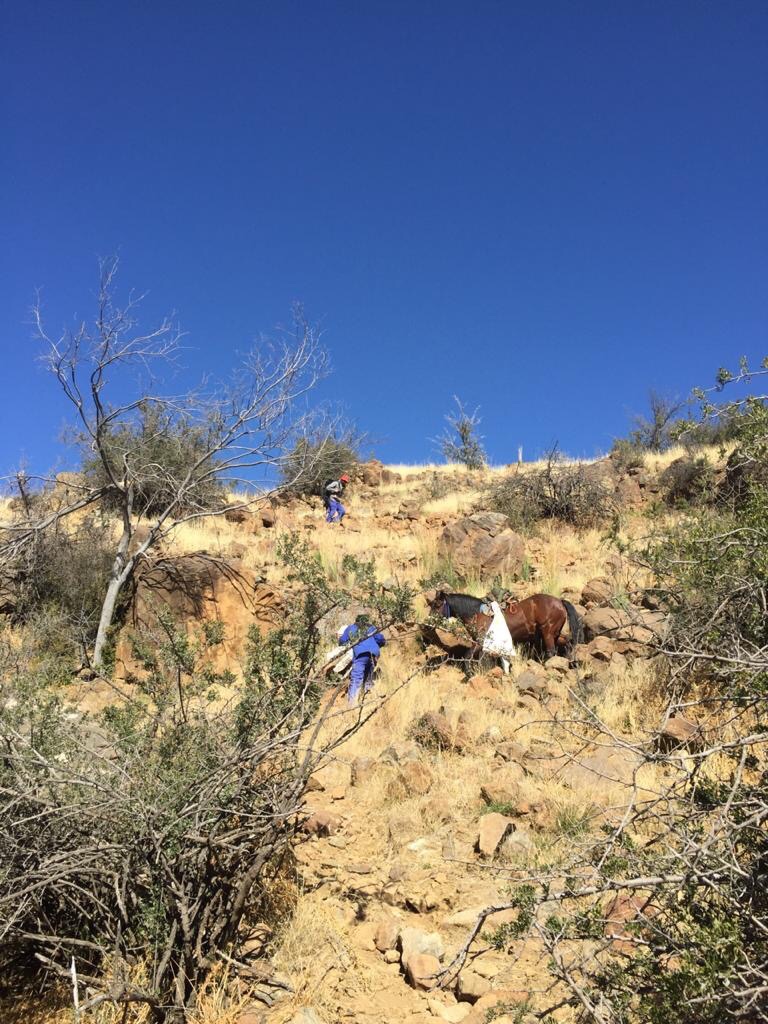
The following morning we were back out early with two horses and our backpacks ready for the recovery. Reaching the supposedly unrecoverable animal we began to load the carry bags on the horses. The one horse was very uneasy with this as it had never experienced anything like this before. It was decided not to cause the horse any undue stress and therefore she was let off the hook from carrying. The rest was put into the backpacks and the long hike back to the vehicle was underway.

Sometime later the vehicle was reached and a well-deserved bottle of water downed to quench our thirst. All the meat was taken to the cold room where it would be hung before being made into biltong (jerky). Except for the tenderloins which I have taken to make waterbuck wellington with. Not sure how it will taste yet but it will certainly be enjoyed by the hunting team around a table in the near future. 

This hunt just shows that when a challenge is accepted and the will to achieve it is there, anything is accomplishable.

I look forward to the next hunt in this area where I am sure we will continue to learn how to make it easier to recover our harvested quarry and prove once again you can hunt successfully in the inaccessible areas.

The Magical Fifty (part two)

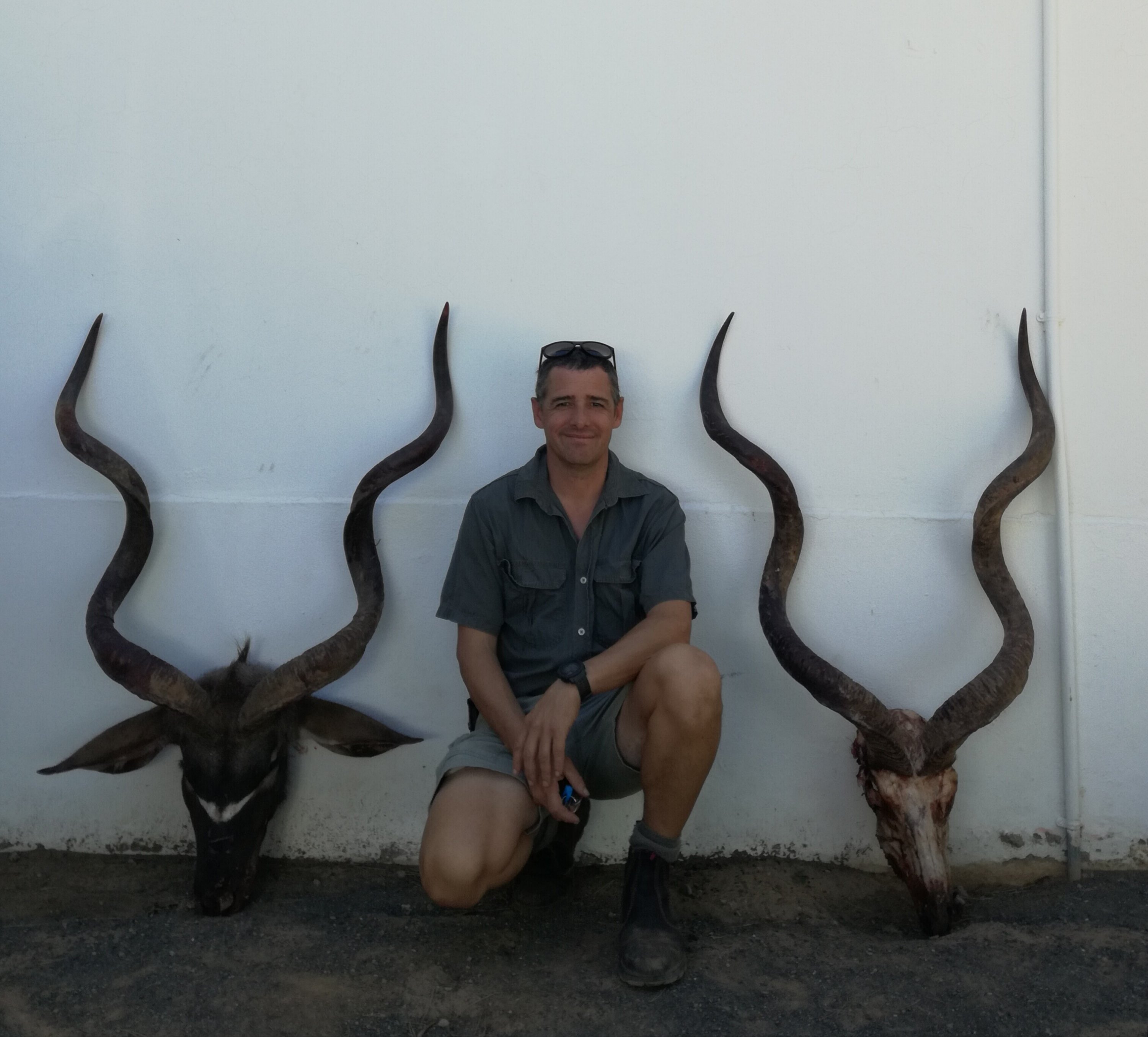
I had cleaned the skull of my kudu (Tregelaphus strepsiceros) and was waiting for a chance to get into town to drop it off at the taxidermy. I was going to have a European skull mount on a shield done, as I already have a shoulder mount of my first ever kudu bull. The bull was too good not to do anything with and of course he was my first fifty inch bull.
A couple of days later my friend, Will, sent me a message and asked if I would like to join him again one morning for another hunt on his property.
I happily accepted his offer as I knew we would have a great morning, even if we were not lucky to get anything. Just being out on his property is a blessing and better than sitting in an office like most would be at the time. If covid-19 had not closed the world down like it had.
Due to the nationwide lockdown, my daughter, Michaela, was doing school from home, which offered us the great opportunity to get out in the bush together. Of course as long as she was up to date with all her school work.
On asking her if she would like to get up before dawn on Monday morning and join Will and myself on a hunt, she quickly accepted.
The weather was the same as the previous hunt. Unusually warm with a slight breeze. The bulls were still being seen following the cow herds as the rut was still undergo. So hopefully the bulls would be easy to find again.
Monday morning quickly came along and we were up well before dawn and meeting with Will on his farm. He said he had thought about what we should do and suggested that he would go and sit at the entrance of the big valleys behind the farm house. He alone on one and Michaela and I should go to the entrance of another along the ridge. We agreed on this and headed off to pick our spots and wait for the sun to rise. Hopefully bringing with it some kudu heading back to their daytime resting areas.
It was still dark so we slowly moved through the shrubs up the side of the rocky hill to a position where we could observe anything coming into the bottom of the valley. We were also able to see the flats below where the kudu would be most likely coming from and therefore had time to get ready or warn Will of anything heading in his direction.
Michaela and I sat taking in the first rays of sunshine coming over our heads and lighting up another beautiful day. We sat with our backs against a small tree with good visibility of the bottom and the opposite side of the valley. I had chosen this spot because in the back of my mind I had decided that if a bull or an old cow came within 200 meters I would let Michaela take it as she had not shot a kudu yet. When I explained my idea to her she was more than keen, as long as it was not over 200 meters.
Starting to scan the flats with my binoculars to see what was moving I soon found some black backed jackal (Canis mesomelas) walking along a distant track heading back to their safe spot after a night of hunting. Unfortunately choosing a valley on the other side of the flats as a rest place and not giving me any opportunity to reduce their numbers in the area. Even though there are only cattle on this particular property, which are not under any threat from the jackal, we still try to control their numbers for the sake of the smaller game species such as duiker (Sylvicapra grimmia) and steenbok (Raphicerus campestris), which are on the jackals menu if they come across them. They also travel through to neighbouring properties where they predate on the farmer’s sheep and goats if they get a chance.
A couple of kudu cows in the distance with what looked like a decent bull slowly made their way out of the riverbed and followed the same route as the jackal. There was no chance these kudu would turn in our direction and I thought to myself “have we sat in the wrong place?”. Never the less, we sat and continued to scan for an appropriate animal to take if it came past.
On the opposite side of the valley some young cows appeared and slowly made their way across in front of us. They were not what we were looking for. We left them to continue on their way and hopefully producing quality animals for the future.
I sent Will a message to see if he had seen anything from his side. He replied shortly after saying a couple of immature bulls had passed him but nothing to shoot.
The sun continued to lighten up the side of the valley in front of us, but it was still quiet with nothing coming past us.
Suddenly Michaela tapped me on the shoulder and whispered to me that she could hear something moving over the loose rocks behind us. We slowly turned and looked to investigate.
She was right and we soon saw what was moving behind us. It was a group of five mature kudu cows being followed by two mature kudu bulls as well as a couple of younger bulls. There was an opportunity here.
The kudu had pulled a fast one, entering the valley higher than we had anticipated and cutting behind us.
We got up and moved in behind a bush where I extended the shooting sticks for a standing shot rather than the expected sitting shot. I chambered a round which again is the trusty 155grain Kriek monolithic copper hollow point, which has given me great results thus far.
I looked at the two mature bulls and decided that the one looked older and slightly smaller in horn length than the other. This was going to be the one we would take.
Moving Michaela into a shooting position we waited for the bull to present a broadside shot. The bull continued to climb away from us and increased the distance between us.
Then suddenly the herd stopped. The wind had slightly changed and took our scent straight to them. Luckily enough we were still in the shadows so they had not seen us but knew there was something around, which they didn’t like.
Unfortunately the bull was not giving us the angle for a shot. He again started moving away from us up the slope.
Michaela then said she was not happy to take the shot anymore as the distance had increased much further 200 meters. Her next comment showed her understanding for what we were there to do though. Saying that I must take the shot as we were there to do a job, which was to take a mature bull.
We swopped places and I took the rifle.
I started to follow the bull in my scope and let out a whistle to try to get the bull to stop. It worked and the bull stopped and looked straight back at us. He stayed quartering away and in my scope I quickly worked out where I would have to place the bullet for a clean kill. Squeezing the trigger, the bull jumped as the bullet struck him.
Michaela celebrated: “you’ve hit him, his tail went up and I heard the thud of the impact!”.
The bull only went about thirty meters before succumbing to the bullet. Falling backwards over some rocks and lying motionless above us on the slope.
We made our way up to where he lay following a very obvious blood trail, which anyone could have followed.
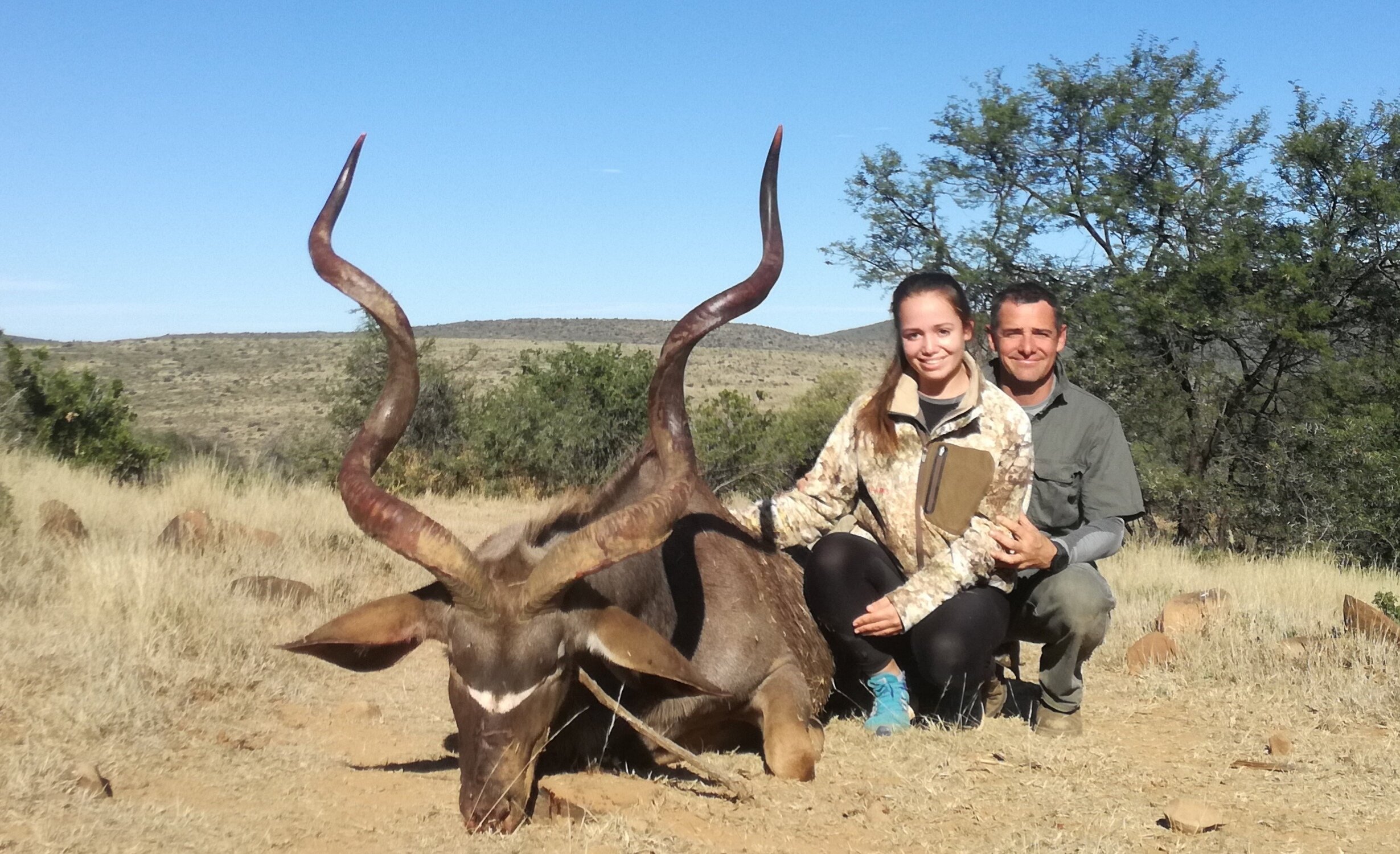
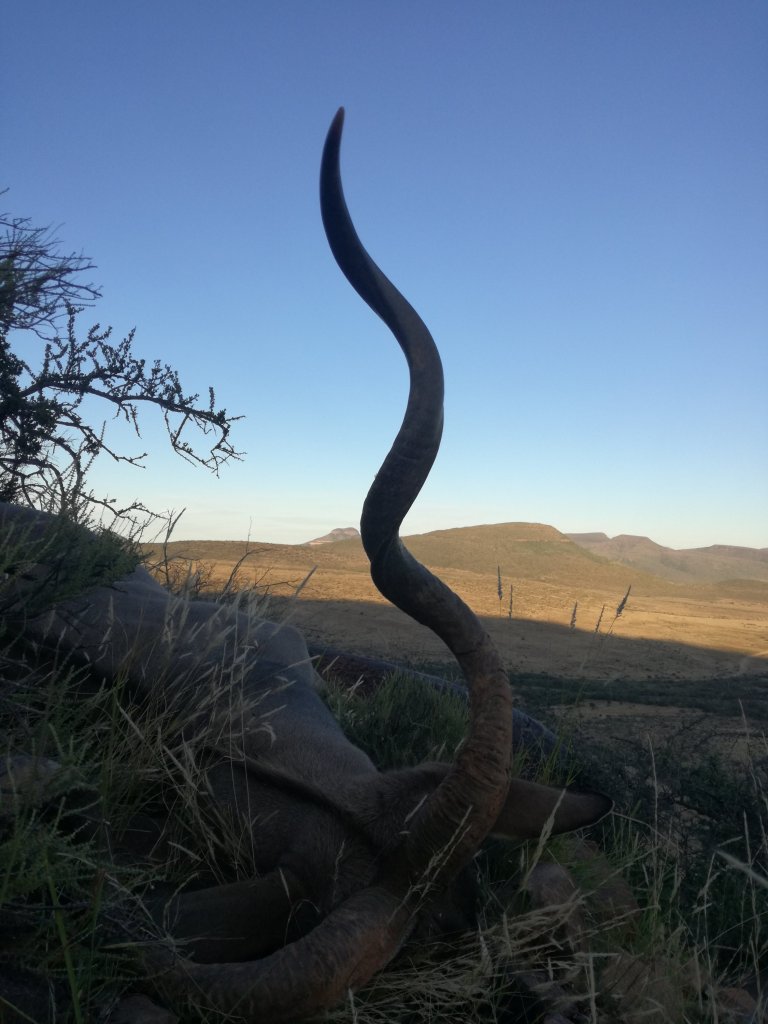
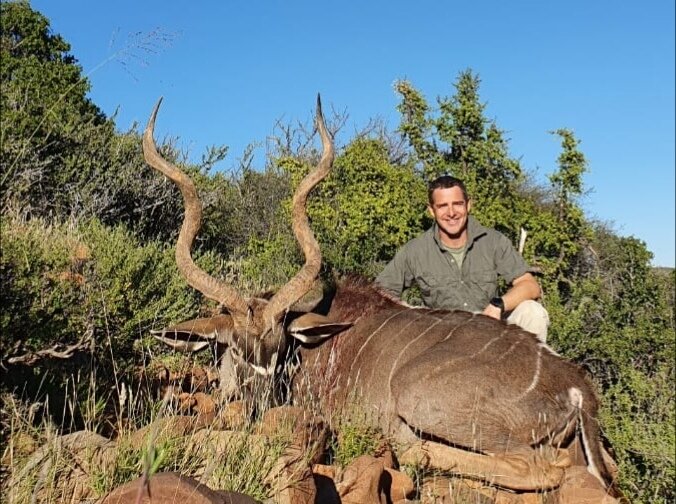
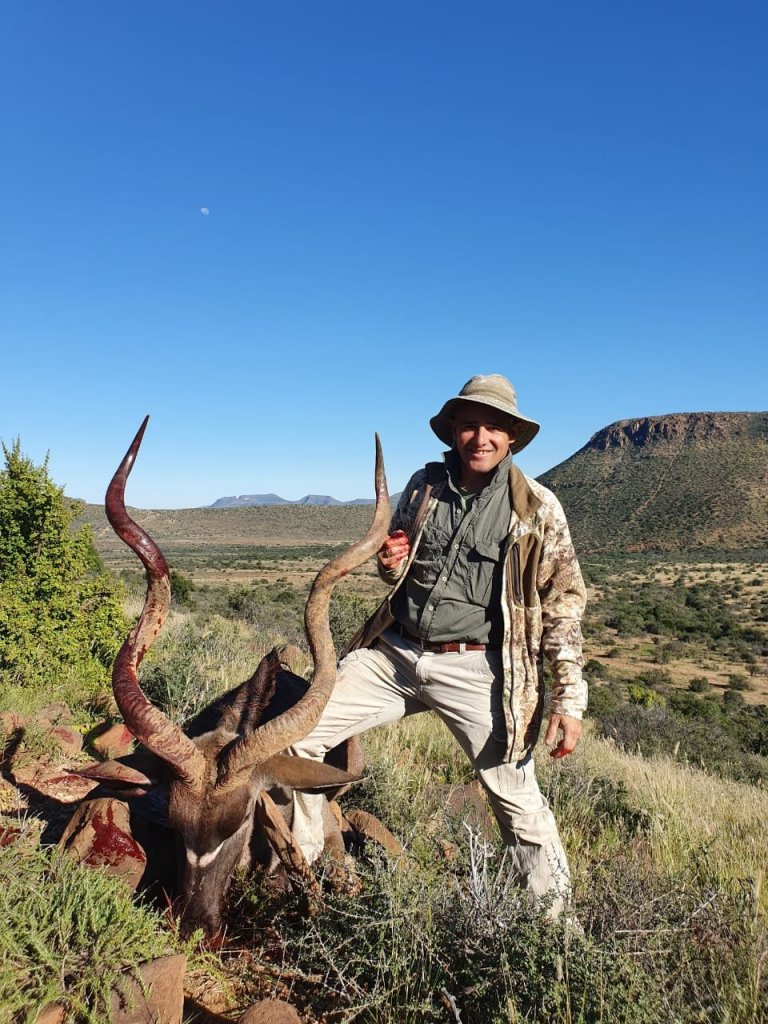
I stood over him and took in what had just happened. He was certainly an old bull, with his teeth worn down and passed his prime. Two things which were not worn down though were the magnificent spiralled horns on his head. Both with ivory tips and deep long curls. One horn slightly deeper than the other but both showing everything you want in a kudu bull.
The thought crossed my mind that this bull was possibly as long as the magnificent bull I had hunted only seven days previously.
Sending Will a message to say we had been successful, the recovery team was dispatched to come and help. The bull was placed carefully on the stretcher and carried down over the rocks to the vehicle.
Photographs were taken and we discussed what the possibility was of this bull also cracking the fifty inch mark. Surely I couldn’t have taken two fifty inch bulls in such a short space of time.
When we got back to the skinning shed we got the tape and followed the curls. Both horns were fifty-one inches. Slightly longer than the last bull.
The two sets of horns would be taken in to the taxidermy on my way home so that their trophies would be forever on view in my house. Hopefully there to inspire others to manage their kudu populations like Will has done over the past few years to produce such great trophies.
The carcass was weighed and came in at 142.2kg on the hook. Of which everything would be processed for the farm. I am looking forward to seeing his horns on their return home from the taxidermy and to enjoy one of the steaks on the fire sometime soon.
Just in case you are wondering, Michaela is still on for a kudu. We will get one for her and let you know how that hunt goes in the near future.
Thank you to my host and friend, Will, for so many great days out in the bush and for the chance to bag some trophies of a lifetime.

The Magical Fifty (part 1)

In all sports there are magical numbers, which competitors strive to get to.
Hunting is no different. Some of these would be numbers like, 40 in for sable (Hippotragus niger), 100lb for elephant (Loxodonta Africana) and in the Eastern Cape of South Africa the magical number is 50. This 50 inches, is all to do with the Eastern Cape kudu (Tregelaphus strepsiceros).
Recognised by SCI as a sub specie of the greater kudu, which found further North in South Africa. The Eastern Cape kudu is usually slightly smaller in body but darker in colour. The spiralled horns don’t often reach the lengths of the Northern relative with the former SCI registration length starting at 98 inches and the later starting at 121 inches. The measurements are taken in exactly the same way, length of the two horns following the spiral and the circumference of the two bases. Despite this, for me they are just as impressive and the hunts are some of the best to be had.
In the area where I hunt these magnificent animals they spend most of their days in the thick bush of the deep valleys. Emerging in the late afternoon, heading into the open flats to feed during the night and retreating back into the safety of the valley as the sun begins to rise.
Good knowledge of the hunting area and the animal movements is paramount to a successful hunt. Luckily enough I have spent a considerable amount of time in the area and my hunting companion, Will, is on the ground there every day. Down to this we have had a number fantastic hunts over the years resulting in some magnificent bulls only matched by the amazing stalks.
A good number of kudu had been seen, including some great old mature bulls. These would be our primary target. An old cow or bull with less than average horns would also be taken if they presented themselves.
The rut was in full flow and the bulls were in fantastic condition with thick necks and good body weight. Where ever we would see cows it was likely there would be a good bull accompanying them. Even though this makes it easier to locate the bulls it also makes for difficult hunting due to the number of eyes on the lookout.
Will and I met before dawn where the plan was set. We would head to higher ground where we would be able to see the herds moving back to their safe places as the sun rose. We would be in radio contact, so that we could inform each other of anything we saw heading in the direction of the other.
The sun rose and quickly we saw good numbers of kudu heading towards the valleys. We were too late. The moon was wrong and the kudu had past our positions in the dark. We would not be able to stalk in on any of the groups we could see.
We relayed this and discussed the next option. We would head to the other section of the farm and walk along a dirt track that followed a river bed into a long valley.
Leaving the vehicle we started our walk. Both thinking it was just going to be a pleasant stroll in the morning with little chance of getting a shot. Listening to the doves and enjoying the beauty of an African morning in the bush we walked slowly along.
All of a sudden there was a clatter of hooves on the loose rocks along the side of the valley. Both stopping, knowing it was only kudu that would be making the noise. Quickly the shooting sticks were out and my rifle was up.
There about 280 meters away we saw a bull moving away behind a small herd of cows. He was magnificent.
Will quickly said to take him. Looking through the scope I could see that this was going to be a special moment.
I whistled. A ploy which is often used to stop a kudu and make them look to see what the noise is. It worked. He stopped and stood quartering away but looking back at us. Putting the cross hairs half way up the body and placed that the bullet should drop into the engine room and exiting on the opposite shoulder. I squeezed the trigger. The 155gr, 308 Kriek bullet was sent on its way.
The bull jumped in the scope.
Will said it’s a miss. As he saw the bullet hit the dirt above the bull. In my mind I couldn’t believe it. The bull must have been hit. He suddenly slowed in his run and crashed into a bush. The shot had been good. Not even rolling around, he was motionless on the side of the valley.
We started our way up to him while the cows and other bulls we had not seen made their way hastily away from us. Coming to the spot he had been standing when I took the shot we saw a few drops of blood and his hoof prints where he had been standing. Looking in the direction he had run we quickly saw large amounts of blood, increasing in volumes as it went.
Quickly we came to his lifeless body. A magnificent bull with spiral horns exceeding anything I had shot before. Both Will and I enjoyed the moment and discussed the quality we had before us.
The recovery team was called and we sat by the bull and waited. Appreciating what we had in our lives and that we were both very grateful that this great bulls genetics had most definitely been passed on to produce future great bulls.
The team arrived and the bull was recovered and taken to the skinning shed.
I am not a hunter who hunts with a tape measure but Will and I both agreed that one should be got and the impressive spiral horns should be measured. Both of us having that magical number on the tips of our tongues. A tape was brought and a measurement taken. We both looked at each other before checking the spot on the tape. Both waiting in anticipation.
50 6/8 inches. I had broken the 50 and it was my first bull reaching this magical number. We both congratulated each other. Will congratulating me on a magnificent trophy and myself congratulating him on producing fantastic bulls due to good management.
A space would be needed for this guy on the wall of my trophy room. So his impressive quality could be enjoyed for years to come. I decided a European mount would be done and I had just the spot for him in my mind.

HUNTING SPRINGBOK IN THE WIND

It was arranged. A group of five family members would head to the Eastern Cape to help reduce the springbok numbers on a low fenced stock farm. With sheep, goats and springbok on the property this was necessary as they would all be competing for the same food.
We would be wanting to take off between 40-50 animals to ensure that there would be enough grazing for the remaining animals over the winter which was quickly showing its head. With temperatures dropping and days being short.
There would be no discrimination between males and females. Whichever stood nicely for the hunter would be taken. The carcasses would be taken, as orders for venison had been given by non-hunters wanting healthy meat for the freezer. Nothing on this hunt was going to waste, with the fifth quarter (offal) was to be taken to a large cat rehabilitation centre as a food donation for their animals.
The plan would be for the hunters to be placed out with comfortable shooting chairs designed especially for this job. They would be given an arc of fire which they would stick to and wait for the buck to come past. Keeping the animals on the move would be the job of the horseman. He would not chase the herds but just move around, making his presence known to the buck which would move them on without spooking them too much.
The ground was mainly flat grassland with some low ridges. All the arcs of fire would be towards the boundary fence for safety reasons as nobody wants a stray bullet passing them unexpectedly. Luckily enough it was not the hunter’s first hunt and they were exceptionally careful. Which is a great relief for an organiser as nobody needs an accident in their hunting career.
There was an array of calibres to be used on the day. Everything from .222 through to 308Win, and predominantly manufactured by Howa. There was one similarity between all the rifles though. This was that they were all topped with Rudolph Optics scopes. Not particularly familiar with this glass I was looking forward to seeing how I got on with it. I can assure you I was impressed with what I saw. It proved to be great value for money and a great range of optics. The scopes were clear and the dialling turrets worked perfectly as they should. The range finder binoculars were also very impressive and proved their importance at the end of the day.
We arrived at the hunting area and the guns were taken to their allocated places. The horseman put on his florescent bib and we were good to go. The springbok were spread around the area calmly watching the strange goings on. A couple of reasonably sized herds could be seen and some smaller groups and individual rams standing out in the open too.
As the horse started on its way towards the springbok, they began to do as intended, move slowly and calmly towards the guns.
All the guns had suppressors on so it was difficult to know when a shot had been fired but when watching with the bino’s you saw their reaction which proved someone had fired. Standing within the arc of fire you would suddenly see them jump and run. Leaving one of their kind behind on most occasions.
These guys could shoot and knew their stuff. The wind was picking up, but still they continued to drop springbok out to 350 yards by dialling for wind and distance. It was very enjoyable to watch.
We had two days to hunt so there was no rush. We stopped for lunch. A feast of venison sausage barbequed in the river bed over thorn tree coals. During which time we discussed what the plan was for the afternoon. Very similar to the morning to be honest I told them.
There was a slight change in the weather after lunch. Not to the positive side, but an increase in the wind speed which would continue until the end of play for the first day.
Total count for day one was 19 dead, none wounded. Which in my opinion was good going for the conditions especially when you saw the shot placement. A number of head shots and the rest were perfectly on the shoulder.
On day two we were met with slightly lower wind speeds at the start but the forecast was for near on gale force as the day went on. We would need to get as many in the bag as early as we could, was the feeling from all involved. We quickly got into our positions and the hunt was underway once again.
This time one of the guns would stay with me. I was also going to be moving the springbok around but using my vehicle instead of the horse. This I was quite keen on as I would get to see how their optics would give them an increased advantage when used correctly and together in these difficult conditions.
The springbok now had a good idea of our intentions and were on the move as soon as we started. Rarely standing still for long. Even with this I could see the guys were having some success but we knew we had to make it to at least 40 to make the hunt successful.
The client with me asked if it was ok if he got on the back of the hunting vehicle and shot from there as it was a cull and numbers were needed. I agreed and he climbed on the back and made himself comfortable. We would work together on this. I had his Rudolph range finder binoculars, so could quickly tell him the distances so he could dial for the exact distance. We soon came across our first ram. He was slowly walking towards us and was unaware of our presence due to the sun being directly behind us. I got him in the bino’s, pressed the button on the top which brought the ranger finder into use. One more press of the button and we had him at 256 yards. This was quickly relayed and the dials were done. Watching through the bino’s the shot went off. He dropped where he had stood. We had decided not to go for the head due to the wind but looking at the shot placement we could have quite easily. It was exactly where it had been intended, perfectly in the engine room.
After this another six fell to our combined effort of ranging and shooting. The time began to run out and contacting the other guns we agreed we had had a good day and all had had some sport. Total bag at the end was 42 springbok dead with none wounded.
All in all it was a success. I was very impressed with the Rudolph optics range and if you are in the market for a new scope for your rifle it is worth having a look at what they have to offer. The range finder bino’s were also good value for money and ranged far beyond mine and probably most hunters capabilities of shooting. I think I will be changing some of the glass which is in my gun safe soon.

A FIRST FOR ME

Many people think that professional hunters get to hunt all the time. This is partly true but the final part of the hunt, the shooting is normally done by the client. Don’t get me wrong, we do get to hunt for ourselves but rarely on the ground that we take clients to.
The game on these concessions are managed and controlled to produce the best quality trophies for the overseas market, but I have fortunately been given the opportunity to hunt one of these concessions on my own without a client over the past 5 weeks.
As usual when I hunt for myself everything which I get to hunt I class as a trophy. Whether it is a big kudu bull or a cull springbok ewe, the hunt is the important thing for me.
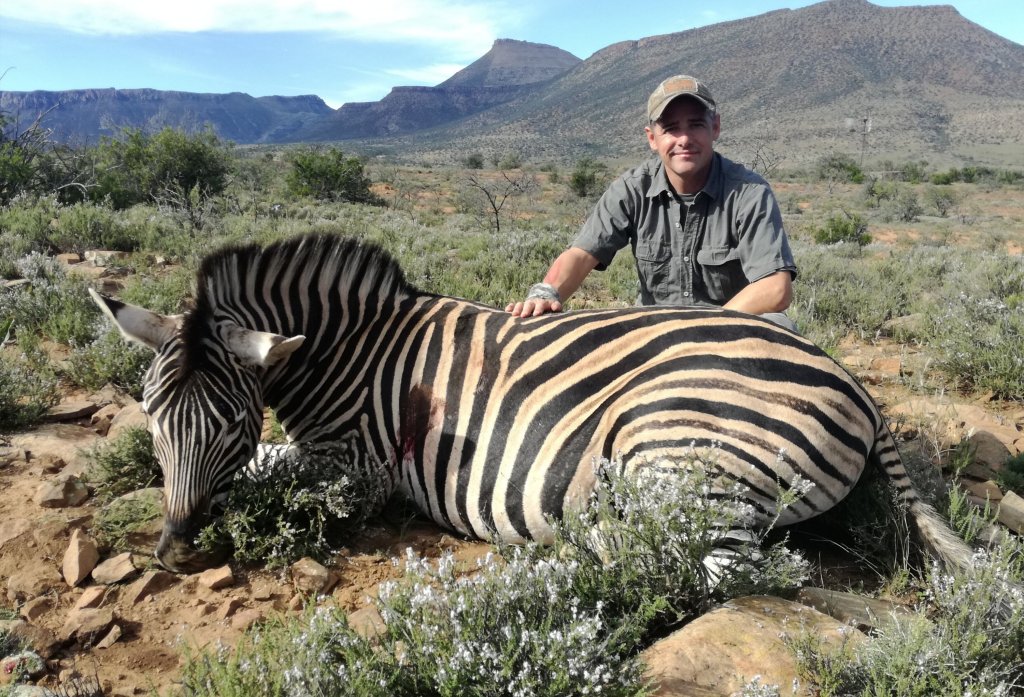
On this occasion I was pretty much given an open list of animals to go after. Meat was needed so it was necessary to cull larger animals ideally. With being in Africa pretty much everything is eaten. Zebra (Equus quagga burchelli) is also on this list as the meat is processed and very little of any carcass is thrown away.
I arrived at the property early, ready for a full day of hunting. The weather was quite warm for the time of year with the snap of winter not arriving yet. The terrain is very varied. From high mountains with steep slopes to the open plains. We would be mainly be concentrating on the plains and the foothills of the property. This being for a speedier recovery of the animals.
My usual equipment for the hunt would be the same but I was making one change. This would be a new bullet, which I had not tried before. It is a South African produced monolithic copper hollow point made by Kriek bullets. My choice is 155gr as that seems to be what my 308win likes.
Myself and Mandla, one of the trackers on the property would go out and then radio through if we needed anything recovered. The plan was to drive to areas and then glass with our binoculars for suitable animals and then stalk in from there once a plan had been put together.
We headed out, myself driving and Mandla on the back keeping a visual as we drove to our lookout spots.
At our first glassing spot, we could see a herd of gemsbok (Oryx gazelle) down below in the thickets but they were not on the list of animals which we could take so we kept searching. Suddenly about 2km’s away I could see a herd of zebra moving out onto an open plateau. It would make for a good stalk and we would have to get everything right as on this property the zebra are very skittish due to being hunted. They will take flight for any unknown reason and head for the high ground. Giving them the advantage of being able to see any approaching threat.
We quickly put a plan together and started to drive down to where we would begin our stalk in on them. The next thing, the herd of gemsbok which we were nowhere near started to run. Unfortunately straight through the open plateau and therefore spooking the zebra which took off as though a pride of lions were after them.
They headed off the plateau and out of site. Presuming that that was over we drove on to see what else we could find.
We stopped again to glass and quickly picked up a bachelor herd of impala (Aepyceros melampus). Though not a target specie for this hunt we could take out rams with broken horns. We looked through them and noticed that there was one such animal in the group. He was a bigger male from the herd who had probably broken a horn fighting another ram in the rut. These rams are taken out as they often hill other rams in the fights as is often the case with many other deer species.
We left the vehicle and started our approach. Using the contours of the ground and the small thickets of acacia bush we would be able to get into shooting range quite easily.
As we reached the edge of the last thicket we caught a glimpse of the ram just disappearing over the ridge onto the open plateau where the zebra had previously been. This would make it nice and easy. We could slowly stalk up to a position undetected and have an open shooting area to look over for him unobscured by trees.
As we approached the ridge where we planned looking from I noticed about 400 meters to our left on the edge of some bush stood a herd of zebra completely unaware of our presence.
The plan quickly changed. The target would now be the zebra as we knew that the bachelor herd of impala would stay in the area as they are reasonably territorial.
It was not going to be easy to get close to the zebra as the cover was sparse between us and them. A couple of trees and that was it. We would have to give it a go though. The wind and the sun were in our favour though so we could give it a go.
Keeping the trees between us and them we slowly moved forward. As we closed the distance it got more difficult as the herd was slightly spread out. So where we were obscured from one another was in view. Only moving when we could see nothing was looking in our direction we eventually got in to 200 meters.
Staying in the shadow of the last tree we slowly prepared the shooting sticks.
Suddenly the zebra sensed there was something wrong. A couple starting to slowly move around while a couple of others looked in our direction. We stood dead still, knowing that they would bolt if they made us out.
The rifle was on the sticks and I just needed one to stand broadside for me to take a shot. Looking through the herd I could see that there were a few foals so really had to be careful as not to shoot a mare. Looking through my scope I saw an individual which was noticeably bigger in body than the others and with closer inspection it was obvious that this was the stallion. I had him in the scope but just needed him to turn for a better shot and for the one behind him to move. Slowly the one behind moved to give a safe shot but the angle was slightly quartering away.
I would have to readjust the shot for the angle. Keeping the horizontal line with the top of the triangle on his shoulder I aimed so that the bullet would be passing through for the opposite shoulder.
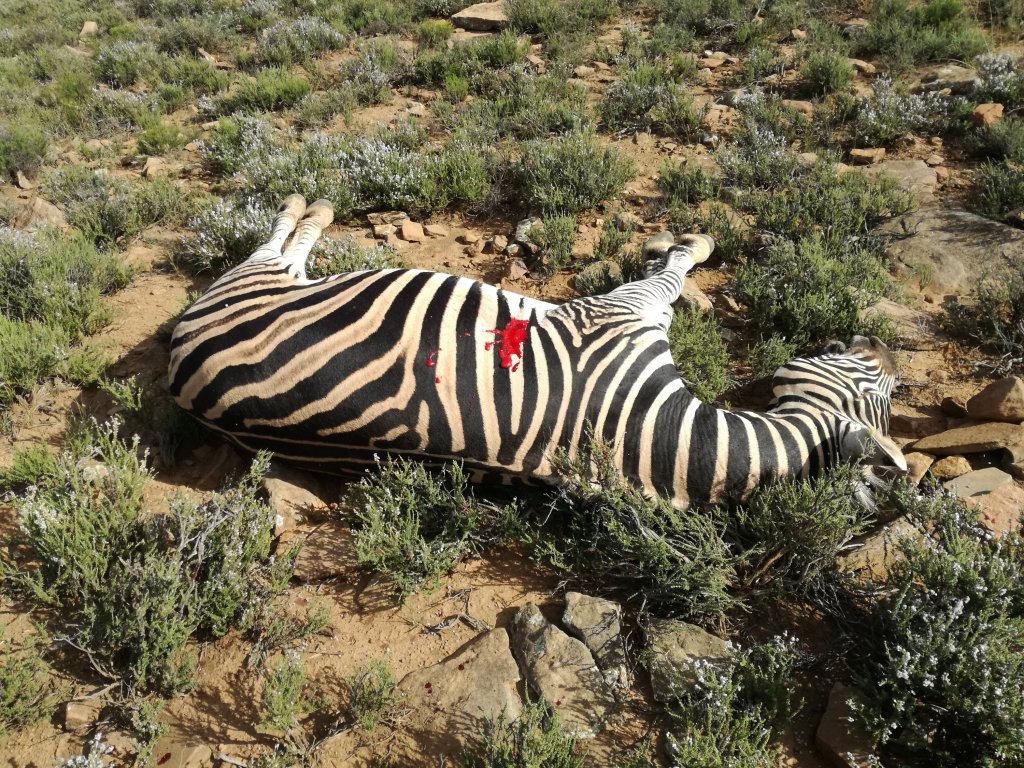
He took a step forward and I knew the time had come. Squeezing the trigger the shot went off and the Zebra lunged forward. Chambering another round I readied myself for a second shot. He ran in a circle obviously hit hard and then his front legs gave way. He was on the ground in a cloud of dust.
The others bolted at the shot but realising that the lead stallion was not fleeing stopped. All standing on the ridge looking down at where he lay. Motionlessly where he fell.
We approached him and with this the rest of the herd moved on with a thunder of hooves and the unmistakable braying of an alarmed zebra.
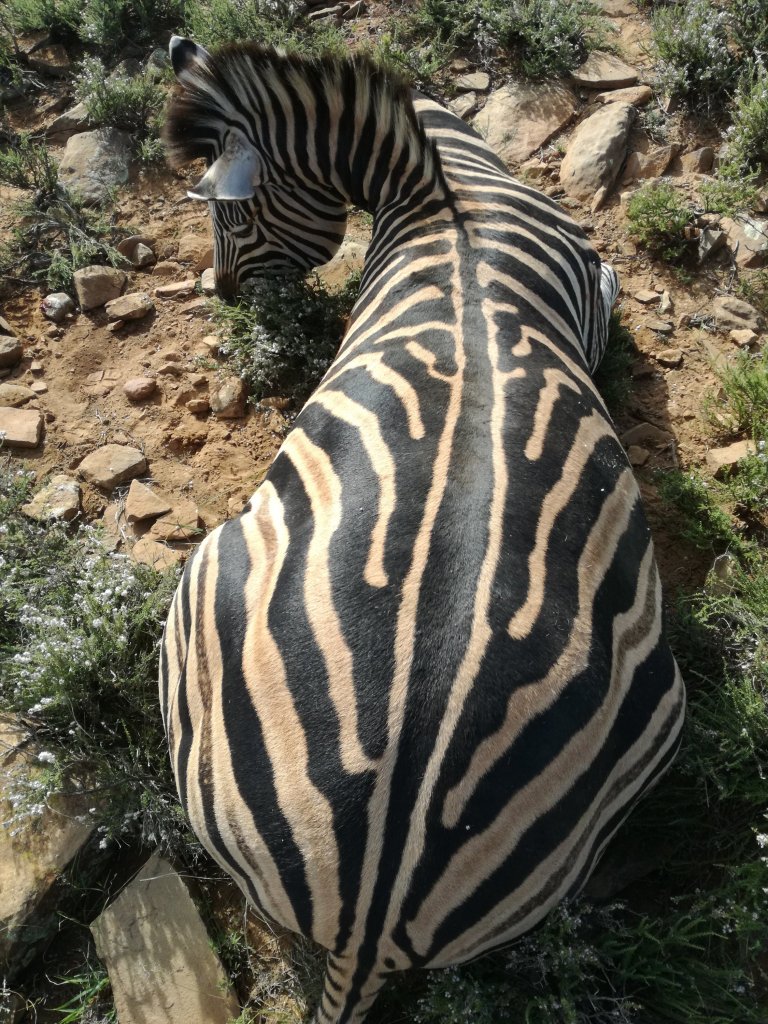
He was a beauty, my first zebra which I have hunted for myself. A new specie for me to tick off my wish list and certainly an African icon.
On closer inspection the bullet had performed perfectly. It had hit where I had aimed and penetrated the entire animal exiting the opposite shoulder. Leaving a clover shaped hole in the skin identifying that the bullet had mushroomed perfectly and done its job well.
Since this I have taken a number of different animals with these bullets and have only recovered two. All the others have passed through and they have all been one shot kills. The two I have recovered have both been from cape eland cows weighing in at around 400kg’s. The bullets have mushroomed perfectly and maintained well over 90% of their original weight. I think I’ve found the perfect combination for my hunting rifle now.

TROPHY IN THE DARKNESS

As we sat in darkness, waiting for our nocturnal prize, the only sound we could hear was that of the ocean breaking on the beach on the other side of the dunes.
A feeding area had been set up months before, and a trail camera placed out to record activity once the sun had gone down. From this information it was determined that a suitable trophy was coming in every night. The feeding had continued and a light had been put up.
The dim red light in the distance was on permanently but had a motion sensor attached so as soon as something came in, it would shine brighter. This bringing your attention back onto the task at hand.
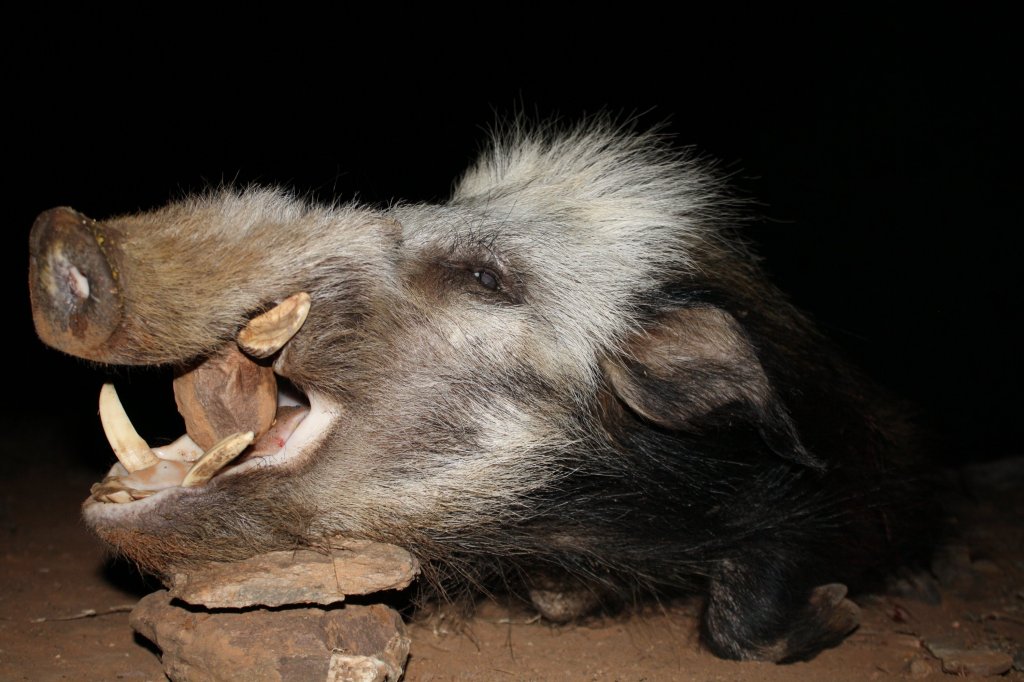
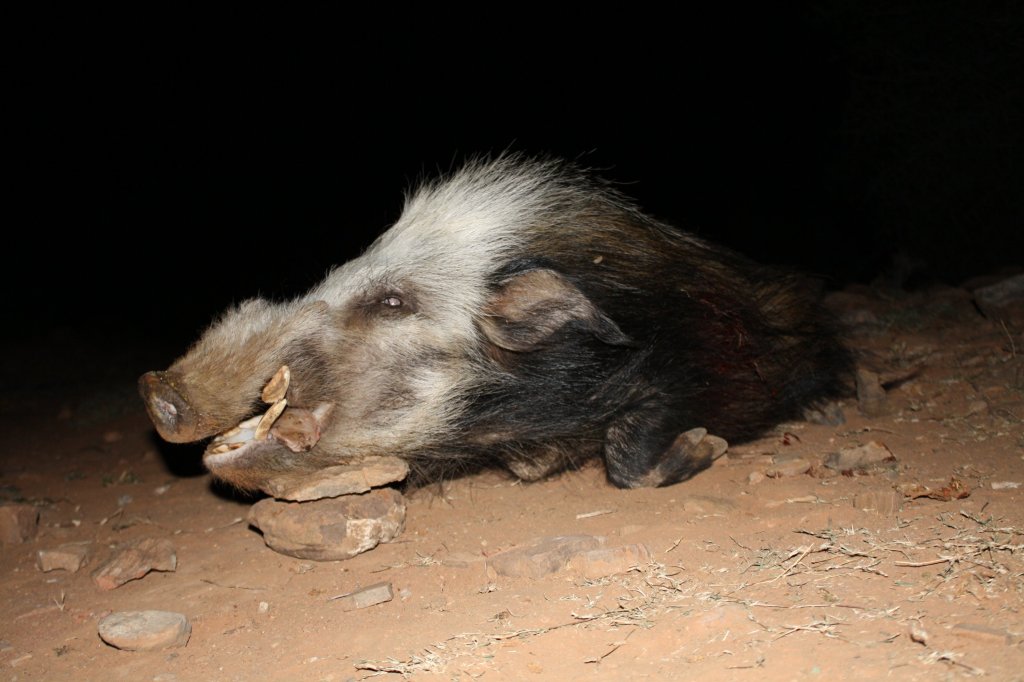
The quarry that we were after, was the bush pig (Potamochoerus larvatus), a nocturnal animal of habit. Standing between 60-100cm at the shoulder, and weighing in at up to 150kgs, Their appearance is more like a domesticated pig than a warthog (Phacochoerus africanus). Their bodies covered in a coarse hair with the older sows and boars having long white hair on the top of the heads and backs. Living in the thick bush, they rarely come out unless under the cover of darkness, but are animals of routine so once they are on a bait they will continue coming in if the feed is available.  They have exceptional hearing and fantastic sense of smell too.
Another thing which I have found is that their eyes don’t shine up at night with a spotlight. I have seen them while out spotlighting for predators but it’s the dark shadow which brings them to your attention. I have even seen them on occasions push into a bush with only their rear end sticking out, therefore blending into the shadows.
Anyway back to this particular evening.
We had driven in just before dark, and left the vehicle hidden behind a sand dune and walked quietly into the prechosen shooting spot. The trail camera had given us the time of 20:00 as the preferred time they arrived in to feed. There were a number of pigs coming in. A mature sow with four reasonably sized followers and a large boar. Him, showing all the characters which we were looking for in a quality bush pig trophy.  Big in body, long white hair down the length of his back, and the unmistakeable warts in front of the eyes of a boar,
we sat and waited. The sun quickly vanished and darkness fell upon us. There was no moon and soon the red light came on. All attention focussed on this as we waited in anticipation. The sound of the Indian Ocean drowned out any other noise and the mild sea breeze blowing into our faces was perfect.
Soon our first visitors arrived. Not bush pig but porcupine. Eating some of the fresh corn placed out and confirming that the red light motion sensor worked. As they came in the glow increased assuring us that things were good. All we needed now was our boar to arrive. Suddenly the feeder hanging over the bait area spun into action. Throwing corn out and making an unmistakable sound, which I’m sure is like a school dinner bell to anything feeding from them.
We sat fully focussed on the site. Client with his rifle positioned on his shooting sticks ready. Rifle chambered with only the safety catch to push off before firing.
Every now and then I would raise my binoculars just to check in the darkness on the fringes of the red light just to see if I could see anything. The night shadows playing with the mind as you think you see something move but still nothing. Time seemed to stand still, or at least run very slowly as it does when sitting and waiting. Checking my watch to see the time I realised that only 10 minutes had passed since the last time I checked. The magical time of eight was approaching though and we just had to relax and wait.
Still looking at the bating site I thought I saw a something move in the background. Raising my binoculars slowly I checked. A dark shadow with a ghost like white appearance moved in the shadows. The client realised there was something and I gestured for him to stay still and keep quiet. As I watched the light brightened. A bush pig was there. Was it the boar or the sow? Looking again, I could see it was the sow as there were no warts on her face. He would surely arrive soon. The piglets were next visibly smaller than their mother and eating their fill.
Then they were gone. As quickly and stealthily as they had arrived they had vanished. We waited hoping that was not it. I reassured the client he would come and that he should simply, relax… Hoping I was right, I looked again down at the light. The light had dimmed again and nothing was there.   
BANG! The light was bright again. Another dark figure, with the white hair on its back stood feeding under the light. I raised my binoculars slowly. There he was. The warts on his face plain to see.
I gestured with a thumbs up to the client to get ready and we were good to go. As the safety catch clicked off the boar raised his head. Obviously hearing something. We had to take our chance before he moved on.
The shot went off. Momentarily blinding us with the muzzle flash.
Did he get him?
Looking down towards the bait site, a dark mound which wasn’t there before had appeared. It lay motionless. We had our boar.
We made the rifle safe and turned on the torches and headlamps. The client asking did he get him? We walked down slowly from our shooting position. There he was, a great bush pig boar trophy which ended a very successful ten day safari.
We admired the length of his white hair, and the quality of his teeth. This would be a great addition to the client’s trophy room. Photographs were taken and then the vehicle arrived to collect out prize, to take to the skinning room.
It would be a late night for the guys in the skinning shed as a full mount was required to go with the full mount warthog harvested earlier on in the safari.

THE HUNT BEFORE THE WORLD CLOSED DOWN.

2020 will be remembered for a couple of reason but the main one being Corvid-19 closing the world down.
The season was set and looked good. I had had my first clients from Austria in January where we had hunted a number of unusual species. From porcupine (Hystrix africaeaustralis) to bontebuck (Damaliscus pygargus) and a number of predators in between.
My second hunt was with a client from Montana. His first time in Africa and a bucket list which changed regularly as he viewed new species. There were a couple of species which never fell off the original list. These being impala (Philantomba monticola), zebra (Equus quagga), black wildebeest (Connochaetes gnu) and of course the Eastern Cape kudu (Tragelaphus strepsiceros).
The weather was not perfect as it would rain on every single day of the safari. You won’t hear us complaining as in the first week of the safari we received more rain than the previous year in total. We would just battle on and change socks and boots when we came back to camp. The roads were wet and the tops of the mountains were always going to be a risky option, even though this we would have to do as the black wildebeest only live at the top on this particular property.
My client had come with his buddy who of coarse shot his kudu bull on the first evening so the pressure was there from the start.
We would go out and scan the deep valleys for big bulls. Nothing, only young bulls and cows but no shooters. This was his number one animal on his list and really wanted one to go home with.
I suggested that we carry on hunting all the other species on the list and if we came across a quality bull while on a stalk we would deviate away and go after it. He agreed, even though you could see the concern in his face over not giving 100% of the time to a kudu. He understood better when I explained I didn’t want to get to a position where he had nothing to go home with by day five of his safari. Pressure would then be on him and I which neither of us needed as it would just interfere with a holiday of a lifetime.
So we headed to the flats where the grass has now gone into seed and is two and a half feet tall. Here we would look for a springbok to start the skinners on. As we headed to the plain a springbok, obviously a ram by the thickness of his neck ran at full tilt from our left towards the area we would be looking. We left the vehicle and slowly walked in the direction he had headed. Not too far I noticed the top of his horns. Getting the sticks up, we got ready. He walked away but then stopped, turned broadside to us if inviting his demise. The 300 Remington ultra mag announced its presence and the ram dropped in the grass.
After this an impala quickly followed and this made for good cheer in the lodge that evening. A couple of beers were had in celebration of a client’s first African animals.
The next day we looked for a zebra which were known to be a bit skittish and nothing had changed. They had seen hunters before and would quickly move away. Eventually we got in a herd after a good long walk. Which also included a couple of hills to climb. They were intermingled with a herd of red hartebeest who almost gave the game away. Even though they had not seen us moved off for no reason. The zebra slowly moved up the mountain zig zagging through the thick acacia bush. Eventually we got on them again and the opportunity arose for a frontal shot. The zebra reared up and ran off in a complete death run. We quickly found the blood and followed it to where we found a good mature animal lying dead with a perfect shot.
Again the evening was spent discussing the day and that we were still in need of a kudu bull. We discussed plans for the following day and decided as it would be clear at the top of the mountain we would head up there first thing in search of the black wildebeest and if we were lucky could spend some time glassing from there for the kudus below.
Up early we headed up the mountain. We quickly saw wildebeest but nothing worth shooting. I knew of a spot where a territorial bull often lay up if the wind picked up. We approached the edge of the cliff slowly and keeping as low as we could, peered over. There about 140 meters away stood the bull. Nice bosses and fully mature. I gestured to the client to join me at the edge. He moved up next to me, keeping low. I pointed the bull out and told him he could take him. As he got ready the bull lay down. I told him to take the shot and the result was impressive. The bull just rolled over not even knowing what had just hit him.
After this we glassed the valleys from above and saw some younger kudu but again no shooters. We headed back down the mountain for lunch and on the way we decided we would just head to the end valley and wait to see what came out before dark.
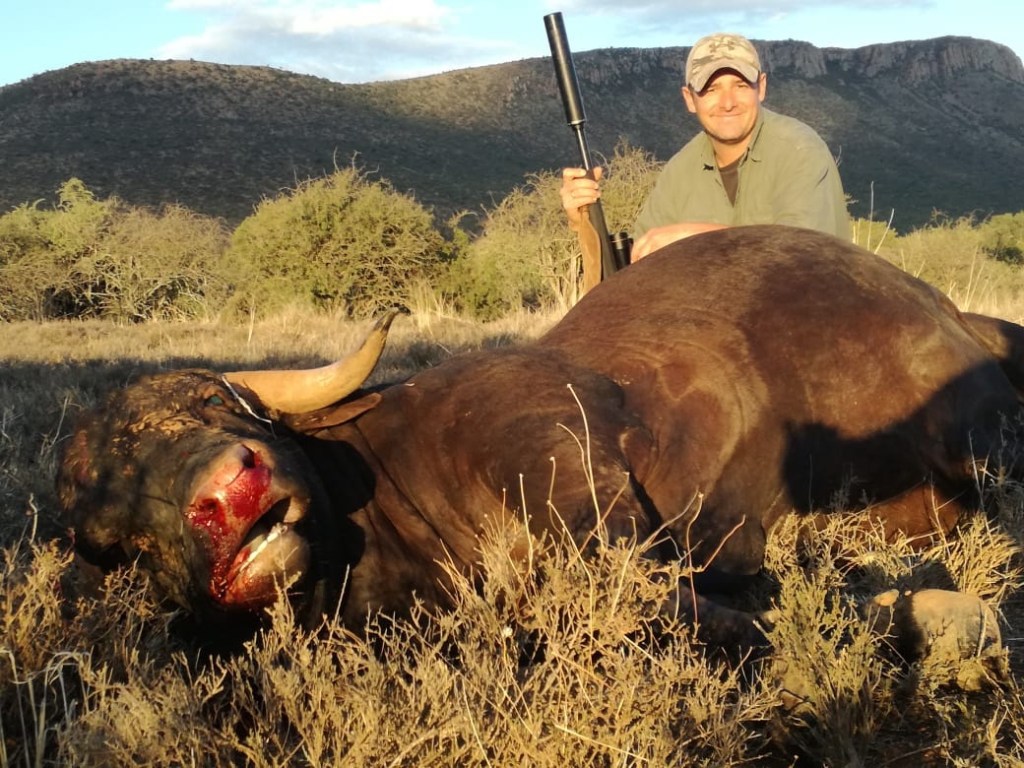
15:00 hours arrived and we headed to our spot. Leaving the hunting vehicle we walked in. Slowly moving to the opening of the valley. Anything which came out we would be able to see. Slowly coming to our observation position the bush erupted. Four mature Cape buffalo (Syncerus kaffer) bulls burst out of the bush in front of us. They had been laid up in the spot we would watch from chewing on their cud. The smell of buffalo was all around. It certainly made the afternoon more exciting.
We sat in the shade scanning the sides of the valley. Every now and then we would catch a glimpse of movement only to find a bull not ready to be hunted. As the sun got lower and knowing that the buffalo were still in the area we started slowly heading back to the vehicle.
Suddenly I saw movement. Raising my binoculars I looked through the bush. Only to find a waterbuck bull. We moved slowly forward and I stopped just to check him out again as I knew There would be clients coming in for waterbuck so would be interested in his quality. As we stopped the unmistakeable bark of a kudu rang out. It was a bull and I caught a glimpse of the tips of his wide horns above the bush. He wasn’t too spooked and instead of running away he moved around in front of us. I got the client ready on the sticks and told him to get ready just in case the bull gave us an opportunity.
He did. Stopping for a split second with only his vital triangle visible through a gap in the trees. I said shoot. Again the loud bark of the 300 rang out. The bull ran but I had seen the bullet strike. We moved forward but there was no blood. Some deep footprints showed the route the bull had gone. We followed them and soon, under a thicket of bush I saw the bull lying motionless. I pointed him out to the client whose face changed the moment he set eyes on his prize.
Photographs were taken before the light was gone and the recovery team set to work. We headed back to camp with only one thing claiming all the conversation. The last chance kudu and a dream come true for a cowboy from Montana.

Design a site like this with WordPress.com
Get started